URS vs. RIRS: Knowing the Best Options For Removing Kidney Stones
When you’re trying to get rid of stones in the kidneys you’re probably looking to get rid of the stones as fast as possible. For those patients considering surgery and researching URS and RIRS I’m here to help you understand it better.
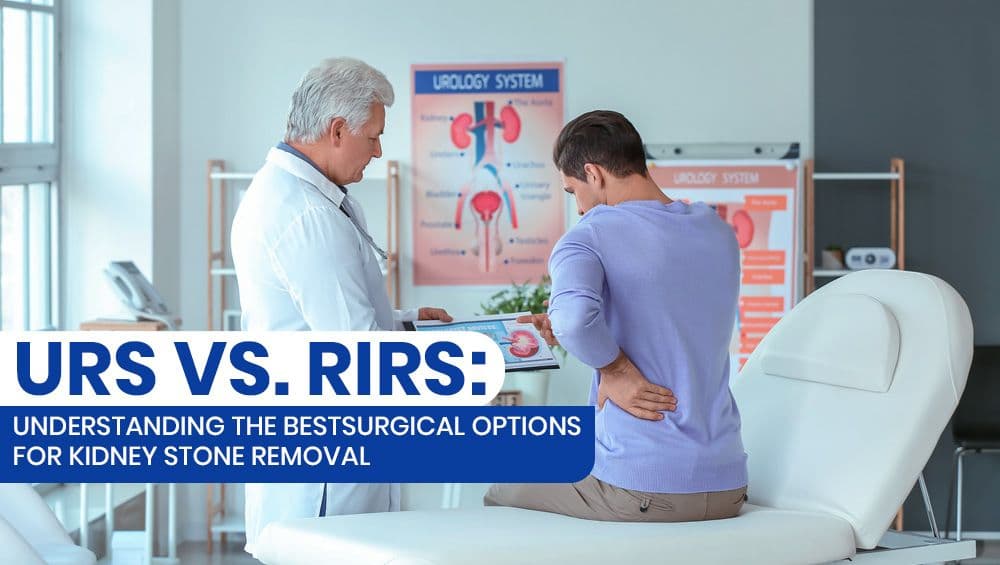
When dealing with a painful kidney or ureteral stone, you want it cleared as quickly and safely as possible. Modern endourology offers scarless, minimally invasive endoscopic solutions that eliminate stones without making external skin cuts. Two of the most common procedures are URS (Ureteroscopy) and RIRS (Retrograde Intrarenal Surgery). Understanding how URS and RIRS compare helps you have a more informed discussion with your urologist to select the best procedure for your specific condition.
What Are URS and RIRS?
URS (Ureteroscopy)
Ureteroscopy is a minimally invasive endoscopic procedure specifically designed to treat stones lodged in the ureter—the muscular tube that connects your kidney to your bladder. A thin, rigid or semi-rigid scope is inserted through the natural urinary tract to locate the stone, which is then pulverized using a laser or extracted with a tiny basket.
RIRS (Retrograde Intrarenal Surgery)
Retrograde Intrarenal Surgery is an advanced extension of ureteroscopy designed to treat stones located deep inside the kidney (the renal pelvis or upper/lower calyces). A highly maneuverable, flexible digital scope navigates all the way into the kidney's collecting system, where high-power Holmium or Thulium laser fibers crush the stone into fine, pass-able dust.
Step-by-Step Procedure Comparison
URS Step-by-Step
- Access: Under general or spinal anesthesia, a semi-rigid scope enters through the urethra $\rightarrow$ bladder $\rightarrow$ ureter.
- Fragmentation: Once the ureteral stone is visualized, a laser breaks it into small fragments, or a nitinol basket grasps it whole.
- Stenting & Discharge: A temporary double-J (DJ) stent may be placed in the ureter to ensure smooth drainage. Most patients are discharged the same day or within 24 hours.
RIRS Step-by-Step
- Access: Under anesthesia, a flexible scope navigates through the urethra $\rightarrow$ bladder $\rightarrow$ ureter, advancing all the way into the renal pelvis and calyces.
- Precision Laser Dusting: The flexible tip deflects into tight kidney chambers. High-energy laser pulses turn hard stones into fine dust.
- Stenting & Discharge: A DJ stent is placed to assist healing and allow remaining dust to flush out naturally. Patients typically go home within 24 hours.
URS vs. RIRS: Key Differences
- Primary Stone Location: URS targets stones stuck in the ureter (middle or lower ureter). RIRS targets stones located inside the kidney calyces or upper ureter.
- Scope Type: URS utilizes semi-rigid or rigid endoscopes. RIRS utilizes flexible digital ureteroscopes capable of 270-degree deflection.
- Incision & Scarring: Both procedures are 100% scarless and require zero skin cuts, operating entirely through natural urinary pathways.
- Stone Clearance Method: URS frequently extracts fragmented pieces with micro-baskets. RIRS primarily uses high-frequency laser "dusting" to pulverize stones into powder.
- Hospital Stay: Both options are typically performed as daycare or 24-hour hospital stays.
- Recovery Timeline: Both offer rapid recovery, allowing most patients to resume normal office work within 2 to 3 days. Read more on can I walk after RIRS surgery and post-surgery recovery.
When to Choose URS vs. RIRS
The choice between URS and RIRS depends on three clinical factors evaluated on a CT scan (CT KUB):
- Stone Location: Stones in the lower or middle ureter are ideally suited for URS. Stones inside the kidney calyces or at the ureteropelvic junction (UPJ) require RIRS.
- Stone Size and Density: For small-to-medium ureteral stones, URS provides quick removal. For kidney stones up to 2 cm—especially hard compositions—RIRS provides exceptional single-session clearance. Read about the success rate of RIRS in complex kidney stones.
- Previous Failed Treatments: If shockwave lithotripsy (ESWL) fails to break a kidney stone, flexible RIRS is the preferred rescue option.
Read our full comparison on RIRS vs PCNL vs ESWL: which is the best treatment for kidney stones.
Recovery, Risks, and Aftercare
Because both procedures are minimally invasive, recovery is fast with minimal pain compared to old open operations:
- Temporary Stent Discomfort: If a temporary double-J (DJ) stent is placed, you may experience mild urinary urgency, frequent urination, or light pinkish urine for a few days.
- Post-Op Hydration: Drink 2.5 to 3 liters of water daily to keep urine diluted and help flush out residual stone dust. Read how much water should you drink to avoid kidney stones.
- Activity Guidance: Walk lightly from the evening of surgery, but avoid heavy strenuous exercise until your stent is removed.
- Dietary Prevention: Follow the right diet for kidney stones to prevent new stones from forming in the future.
Expert Endourological Care in Gurgaon
Both URS and RIRS provide safe, effective, and scarless solutions for stone removal. Selecting the right procedure ensures maximum stone clearance with minimal downtime. For expert urological consultation in Gurgaon and Delhi NCR, consult Dr. Deepanshu Gupta. With over 15 years of experience and thousands of successful endourological procedures (including laser URS, RIRS, and Mini-PCNL), Dr. Gupta provides tailored, patient-centered care.
Frequently Asked Questions
Which procedure is better for a stone stuck in the ureter?
URS is specifically designed for stones lodged in the ureter. If the stone has migrated back up into the kidney, a flexible RIRS scope is used instead.
Is RIRS surgery painful?
No. RIRS is performed under general or spinal anesthesia, so you feel no pain during the procedure. Post-operative discomfort is mild and easily managed with prescribed medications.
How long does a DJ stent stay in place after URS or RIRS?
A temporary DJ stent is typically left in place for 1 to 2 weeks to allow the ureter to heal smoothly without swelling, after which it is removed in a quick outpatient procedure.
Have Questions About This Topic?
Get a personalized consultation at Cure Stone Hospital, Sector 52, Gurgaon.
Book Consultation