
Open Surgery vs RIRS – Which Is Safer and More Effective?
Kidney stones can cause lots of pain and discomfort. If treatments fail, surgery is an alternative.
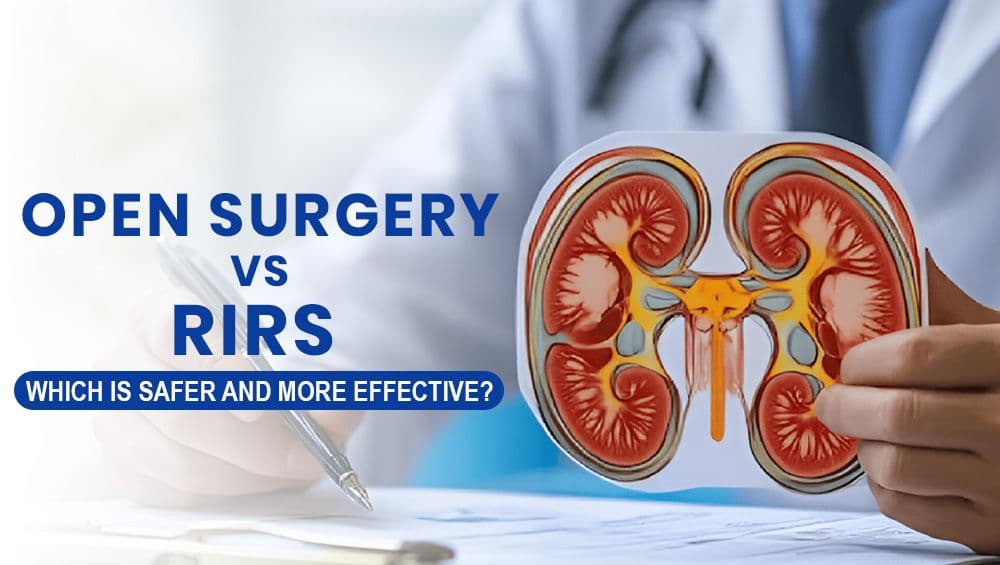
Kidney stones cause significant pain and disruption. When conservative medical expulsive therapy or non-invasive treatments fail, surgical intervention becomes necessary. Two primary surgical approaches used for kidney stone removal are RIRS (Retrograde Intrarenal Surgery) and traditional Open Surgery. While both aim to eliminate stones and restore urinary flow, they differ fundamentally in invasiveness, post-operative pain, and recovery timelines. Understanding these differences helps patients make informed treatment choices under expert medical guidance.
What Is RIRS (Retrograde Intrarenal Surgery)?
RIRS (Retrograde Intrarenal Surgery) is an advanced, minimally invasive endourological procedure. It uses no external skin cuts or stitches. A thin, flexible scope (ureteroscope) equipped with a video camera is passed through the body's natural urinary path—from the urethra into the bladder, up the ureter, and directly into the kidney. A high-precision laser (Holmium or Thulium) is passed through the scope to pulverize the stone into fine dust or small fragments, which are then extracted using nitinol baskets or passed naturally in urine.
Key Advantages of RIRS
- Incision-Free and Scarless: Uses natural urinary pathways with zero skin cuts.
- Minimal Pain and Bleeding: Causes significantly less tissue trauma than open procedures.
- Short Hospital Stay: Most patients are discharged within 24 hours.
- Rapid Recovery: Patients typically resume normal daily routines within 2 to 3 days. Read more on can I walk after RIRS surgery and post-surgery recovery.
- Low Complication Rate: Minimal risk of wound infection, severe bleeding, or long-term scarring.
What Is Open Surgery for Kidney Stones?
Open surgery (open nephrolithotomy or pyelolithotomy) is a traditional surgical method requiring a major incision (7 cm to 10 cm) across the flank or abdomen to access the kidney directly. While largely replaced by modern endourological techniques, open surgery remains an essential fallback reserved for exceptionally large staghorn stones, severe anatomical abnormalities, or cases where endoscopic equipment cannot navigate the urinary tract safely.
Key Aspects of Open Surgery
- Large Incision: Requires a 7 cm to 10 cm surgical cut through flank muscles.
- Extended Hospital Stay: Typically requires 4 to 7 days of inpatient care for wound management and drain monitoring.
- Significant Post-Op Pain and Scarring: Causes noticeable incisional pain and leaves a permanent visible scar.
- Extended Rest Needed: Full physical recovery takes 4 to 6 weeks.
Major Differences: RIRS vs. Open Surgery
- Surgical Access: RIRS enters via the natural urinary passage (scarless), whereas open surgery requires a large flank incision (7–10 cm).
- Anesthesia & Trauma: RIRS involves minimal tissue disruption and low blood loss, whereas open surgery involves cutting abdominal muscle layers with moderate to high blood loss.
- Hospitalization: RIRS requires a 24-hour stay (or daycare discharge), while open surgery requires 4 to 7 days of hospital observation.
- Recovery Timeline: RIRS patients return to normal activities within 2 to 3 days, compared to 4 to 6 weeks for open surgery.
- Infection Risk: The risk of wound infection or incisional hernia is virtually non-existent in RIRS, but higher in open surgery due to the large open wound.
Which Procedure Is Safer?
For the vast majority of patients, RIRS is significantly safer than open surgery. Because RIRS avoids open muscle cutting and skin incisions, risks like severe intraoperative bleeding, wound breakdown, incisional hernias, and hospital-acquired wound infections are drastically reduced. However, safety is also dictated by clinical context. In rare instances involving massive, complex staghorn calculi or severe congenital renal deformities, open or keyhole procedures like PCNL may be recommended to clear the entire stone burden safely in a single session. Read if PCNL is a major surgery.
Which Procedure Is More Effective?
Both procedures offer high success rates when applied to the correct clinical indications:
- RIRS Efficacy: Highly effective (85% to 95% stone-free rate) for small, medium, or multiple kidney stones up to 2 cm. Explore the success rate of RIRS in complex kidney stones.
- Open Surgery Efficacy: Reserved for massive, complex stones over 3 cm or staghorn calculi when keyhole techniques are unfeasible.
Modern urological guidelines recommend starting with endoscopic, scarless procedures like RIRS or Mini-PCNL before considering open surgery.
Recovery and Aftercare Guidelines
Recovery After RIRS
- Expect mild, temporary burning during urination for 1 to 2 days.
- Drink 2.5 to 3 liters of water daily to flush out residual stone dust. Learn why hydration is necessary for kidney health.
- Avoid heavy strenuous exercise for 1 week.
Recovery After Open Surgery
- Rest strictly at home for 3 to 4 weeks.
- Keep the surgical wound clean, dry, and dressed to prevent infection.
- Attend follow-up visits for staple or suture removal and drainage tube monitoring.
Expert Endourological Care in Gurgaon
When comparing RIRS to open surgery, RIRS is the superior, modern choice for most patients due to its scarless nature, minimal pain, and rapid recovery timeline. For expert endourological evaluation and specialized stone removal in Gurgaon and Delhi NCR, consult Dr. Deepanshu Gupta. With over 15 years of surgical experience and thousands of successful endourological procedures, Dr. Gupta provides tailored, patient-centered care for complete relief.
Frequently Asked Questions
Is RIRS surgery completely scarless?
Yes. RIRS is performed through the natural urinary opening (urethra), leaving zero external skin incisions or scars.
Why is open surgery rarely performed for kidney stones today?
Advancements in flexible digital scopes, high-power Holmium/Thulium lasers, and keyhole PCNL allow endourologists to fragment and remove almost all stone sizes without making large abdominal incisions.
How do I prevent kidney stones from recurring after RIRS?
Maintaining daily fluid intake (2.5 to 3 liters of water), limiting excess sodium and animal protein, and following a tailored diet based on your stone's composition effectively prevent recurrence. Read our guide on how to avoid kidney stone recurrence.
Have Questions About This Topic?
Get a personalized consultation at Cure Stone Hospital, Sector 52, Gurgaon.
Book Consultation