Gallbladder Stone Surgery: When Is It Needed and What Does Recovery Involve?
Gallbladder stones do not always require surgery, but symptomatic or complicated stones may need treatment. Learn when gallbladder stone surgery is recommended, how it is performed, and what recovery involves.
Most people who discover they have gallstones do not need surgery.
That is worth saying first, because the usual sequence is an ultrasound done for something unrelated, an incidental finding of gallstones, and an immediate assumption that an operation is coming. In reality, the majority of gallstones never cause a single symptom, and stones that sit quietly are generally left alone.
The decision turns on whether the stones have started causing trouble, and on what kind of trouble. This article covers when surgery is genuinely needed, what the operation involves, and what recovery actually looks like week by week.
Gallstones Are Not Treated Like Kidney Stones
This is the most common misunderstanding, and it matters because many patients arrive having read about laser stone removal and expect the same approach.
With a kidney stone, the stone is broken up and removed while the kidney stays where it is. With gallstones, the standard treatment is removal of the gallbladder itself, not just the stones inside it.
The reason is simple. The gallbladder that produced one set of stones will produce more. Removing the stones and leaving the organ behind results in recurrence in a high proportion of patients, so the definitive treatment is cholecystectomy, removal of the whole gallbladder.
The two conditions are frequently confused by patients because both involve stones and both cause severe abdominal pain. See the difference between gallbladder stones and kidney stones if you are not certain which you have, and gas pain versus gallstones if the diagnosis is still unclear.
When Surgery Is Not Needed
Silent gallstones, meaning stones found incidentally that have never caused symptoms, are usually observed rather than operated on. The large majority never go on to cause problems, and surgery carries its own small risks that are not justified without an indication.
If this is your situation, the sensible approach is to know the warning symptoms, eat sensibly, and get assessed if anything changes.
When Surgery Is Needed
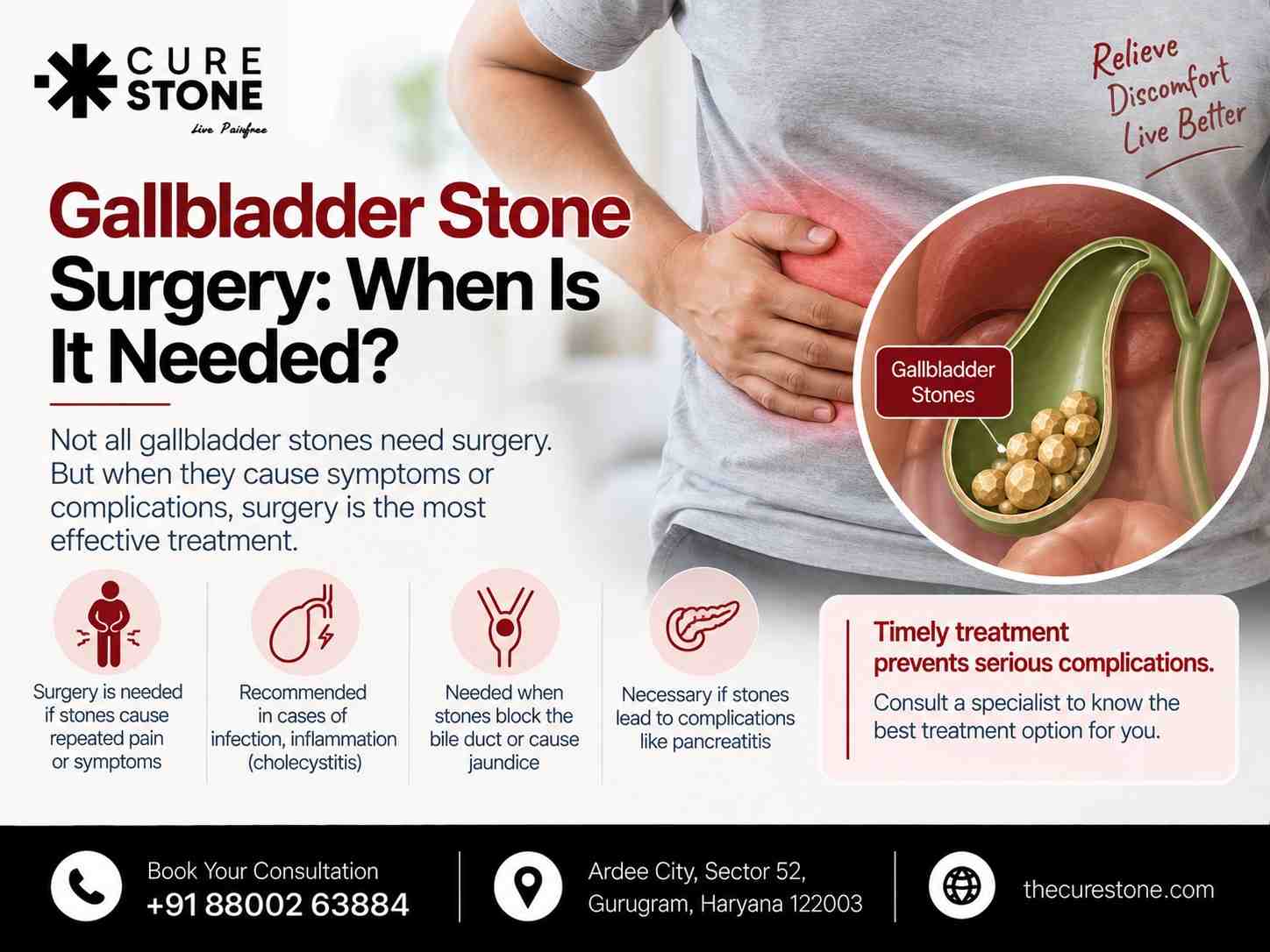
Surgery is generally recommended in the following situations.
Biliary colic. Recurrent episodes of severe pain in the upper right abdomen, often after fatty meals, sometimes radiating to the right shoulder blade, typically lasting from thirty minutes to a few hours. Once stones start causing pain, episodes usually recur and tend to become more frequent.
Acute cholecystitis. Inflammation or infection of the gallbladder, with persistent pain, fever, and tenderness. This needs urgent assessment and usually surgery, often during the same admission.
Stones that have moved into the bile duct. These can obstruct bile flow, causing jaundice, dark urine, pale stools, and itching. The duct stone typically needs clearing endoscopically, followed by removal of the gallbladder.
Gallstone pancreatitis. A stone triggering inflammation of the pancreas. This is a serious condition and surgery is usually recommended during the same admission or shortly afterwards to prevent recurrence.
Structural concerns. Very large stones, a calcified gallbladder wall, or significant gallbladder polyps, each of which carries an increased cancer risk and prompts surgery even without symptoms.
Certain medical conditions, including some blood disorders, where a lower threshold applies.
What About Dissolving Gallstones With Medicine?
Medication to dissolve gallstones exists, but its role is limited.
It only works on small, purely cholesterol stones in a gallbladder that is still functioning normally, treatment takes many months, success is inconsistent, and stones frequently return once the medication stops because the organ that made them is still there.
For most patients with symptomatic gallstones, it is not a realistic alternative to surgery. It is occasionally used in patients who cannot undergo an operation.
The Operation
Laparoscopic cholecystectomy is the standard approach and accounts for the large majority of gallbladder removals today.
Three or four small incisions are made in the abdomen, each typically under a centimetre. A camera and instruments are passed through these ports, the abdomen is gently inflated with gas to create working space, the gallbladder is separated from the liver and its duct and artery are sealed, and the organ is removed through one of the port sites.
The procedure is done under general anaesthesia and usually takes between thirty and ninety minutes. Most patients go home the same day or after one night.
Open surgery involves a larger incision below the right ribs. It is uncommon now, and is used either when a laparoscopic operation needs to be converted partway through, usually because of severe inflammation, scarring from previous surgery, or unclear anatomy, or when it is planned from the outset in complex cases.
Conversion from laparoscopic to open is not a complication. It is a judgement call made for safety, and a surgeon who converts when the anatomy is unclear is doing the right thing. See laparoscopic versus open gallbladder stone surgery for a fuller comparison.
Recovery Week by Week
Day one to two. Soreness around the port sites and, commonly, pain in the shoulder tip. That shoulder pain surprises patients and is caused by residual gas irritating the diaphragm rather than by anything wrong. It settles within a day or two and walking helps it clear faster. Most people are eating light meals and moving around the house from day one.
First week. Discomfort improves steadily. Tiredness is common and often underestimated. Desk work is possible for many people from around day five to seven, though some need longer. Short walks several times a day are the single most useful thing you can do.
Weeks two to four. Most normal activity resumes. Driving once you can brake sharply without hesitation and are off strong painkillers. Light exercise restarts in this window.
Four to six weeks. Heavy lifting, gym training, and strenuous work. Returning to heavy lifting too early is the most common cause of port site hernia, which is worth avoiding.
Open surgery recovery is considerably longer, usually four to six weeks before normal activity and longer before heavy work.
Living Without a Gallbladder
The gallbladder stores and concentrates bile. Without it, the liver continues producing bile, which simply flows into the intestine continuously rather than being released in a concentrated burst after meals.
Most people eat normally afterwards. A lighter, lower-fat diet for the first couple of weeks helps while the body adjusts, then most patients return to their usual food without restriction.
A minority develop looser or more frequent stools, particularly after fatty meals. This usually improves over weeks to months and is manageable with dietary adjustment or medication if it persists.
Persistent pain after gallbladder removal is uncommon and always deserves investigation rather than acceptance. It can indicate a retained stone in the bile duct or a different diagnosis that was mistaken for gallstone disease in the first place.
Risks Worth Knowing
Laparoscopic cholecystectomy is one of the most commonly performed operations in the world and is generally safe, but no operation is risk free. The recognised risks include bleeding, wound infection, injury to the bile duct, a retained stone in the bile duct, conversion to open surgery, and port site hernia. The actual figures, who sits at higher risk, and what surgeons do to reduce it are covered in detail in is gallbladder stone surgery safe.
Any surgeon proposing this operation should discuss these with you specifically rather than in general terms. If that conversation did not happen, ask for it.
When to Seek Urgent Help
Whether you are waiting for surgery or recovering from it, seek medical attention for:
- Fever with abdominal pain
- Yellowing of the eyes or skin, dark urine, or pale stools
- Severe pain that does not settle
- Persistent vomiting
- Increasing redness, swelling, or discharge from a wound
These can indicate infection, a duct stone, or a complication that needs prompt treatment.
Getting the Diagnosis Right First
A meaningful number of patients referred for gallbladder surgery turn out to have something else. Acid reflux, gastritis, peptic ulcer disease, and kidney stones on the right side can all mimic biliary pain closely, and finding gallstones on a scan does not prove they are the cause of your symptoms.
Right-sided pain in particular is a frequent source of confusion, because a stone in the right kidney or upper ureter can produce pain in a very similar area. If the pattern of your pain does not fit biliary colic, that is worth resolving before an operation rather than afterwards. See gas pain versus gallstones and, if kidney stones are a possibility, what conditions urologists treat.
For an assessment of abdominal pain where the cause is not yet clear, or for advice on whether your gallstones need treating, book a consultation. Our specialties page sets out the conditions we treat.
Frequently Asked Questions
Do all gallstones need surgery?
No. Gallstones found incidentally that have never caused symptoms are usually observed rather than operated on, because most never go on to cause problems. Surgery is recommended once stones cause pain, inflammation, duct obstruction, or pancreatitis, or when structural findings raise cancer concern.
Why is the whole gallbladder removed instead of just the stones?
Because a gallbladder that formed one set of stones will usually form more. Removing the stones alone leads to recurrence in a high proportion of patients, so removing the organ is the definitive treatment.
How long does recovery from laparoscopic gallbladder surgery take?
Most patients return to desk work within five to seven days and to normal activity within two to four weeks. Heavy lifting and strenuous exercise should wait four to six weeks. Open surgery takes considerably longer.
Why do I have shoulder pain after gallbladder surgery?
Residual gas used to inflate the abdomen during the operation irritates the diaphragm, which refers pain to the shoulder tip. It is common, harmless, and settles within a day or two. Walking helps it clear faster.
Can I eat normally after gallbladder removal?
Most people can. A lighter, lower-fat diet for the first couple of weeks helps while the body adjusts. A minority experience looser stools after fatty meals, which usually improves over time.
Can gallstones be dissolved with medicine?
Only in limited circumstances, with small cholesterol stones in a functioning gallbladder, and treatment takes many months with inconsistent results. Stones commonly return once medication stops, so it is not a realistic alternative for most patients.
Is laparoscopic gallbladder surgery major surgery?
It is performed under general anaesthesia and involves removing an organ, so it is a real operation. But it uses small incisions, most patients go home within a day, and recovery is far shorter than with open surgery.
Could my pain be kidney stones rather than gallstones?
It is possible, particularly with right-sided pain, since a stone in the right kidney or upper ureter can mimic biliary pain closely. Finding gallstones on a scan does not prove they are causing your symptoms, and an unclear picture is worth resolving before surgery.
Have Questions About This Topic?
Get a personalized consultation at Cure Stone Hospital, Sector 52, Gurgaon.
Book Consultation