Who Is the Right Candidate for PCNL Kidney Stone Removal?
The experience of having kidney stones can be exasperating and uncomfortable. Medications alongside a healthy lifestyle may aid in passing smaller stones, but larger ones often need medical assistance. Percutaneous Nephrolithotomy (PCNL) is one of the most effective treatments for large or complex kidney stones. Is PCNL suitable for everyone?
Kidney stones (renal calculi) can range from minor, passably small crystals to massive, dense formations that block the kidney's drainage system. While small stones can often be passed with hydration or treated using non-invasive techniques, larger or complex stones require advanced surgical intervention.
Percutaneous Nephrolithotomy (PCNL) is widely considered the gold standard procedure for removing large, complex, or dense kidney stones. But is PCNL suitable for every patient?
In this detailed blog, we explain what PCNL involves, who makes an ideal candidate, when the procedure should be avoided, and how it compares to other kidney stone treatments.
What Is Percutaneous Nephrolithotomy (PCNL)?
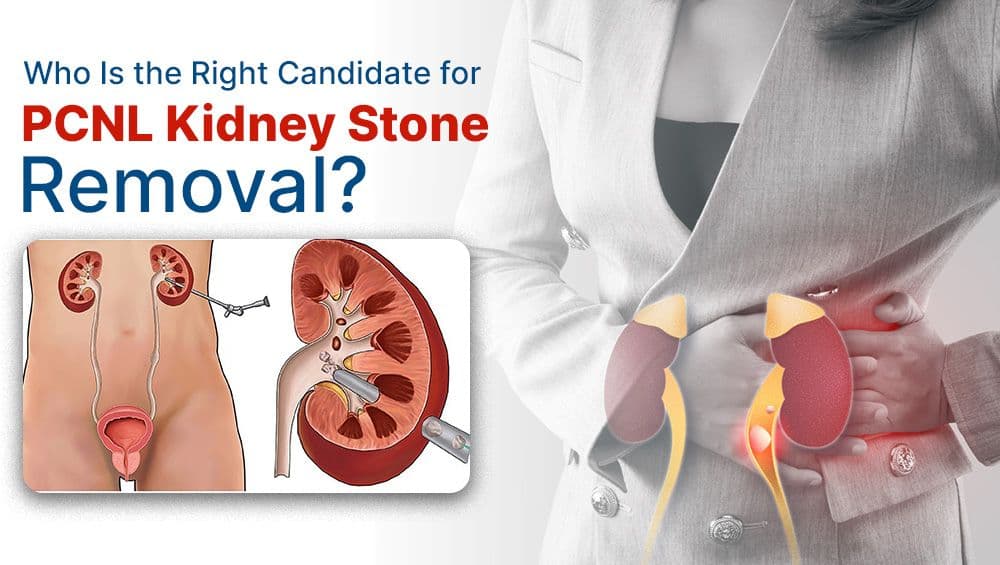
PCNL is a keyhole surgical procedure designed to remove large or complex kidney stones directly from the kidney. Unlike traditional open surgery, PCNL requires only a tiny incision (about 1 cm) in the patient's back.
Through this small access tract, the surgeon inserts a specialized rigid or flexible telescope (nephroscope) to visualize the stone. Using high-power laser energy or ultrasonic lithotripters, the stone is fragmented into small pieces and immediately extracted or vacuumed out.
PCNL offers significantly higher single-session stone-clearance rates (over 90–95%) compared to Shock Wave Lithotripsy (SWL) or Retrograde Intrarenal Surgery (RIRS) when dealing with large stone loads.
Who Should Consider PCNL?
Not every patient with kidney stones requires keyhole surgery. PCNL is specifically recommended for complex stone cases where non-invasive or flexible scope techniques are less effective:
1. Large Kidney Stones ($> 2\text{ cm}$)
For stones larger than 2 centimeters ($20\text{ mm}$), less invasive methods like SWL or standard RIRS often require multiple treatment sessions and leave behind residual fragments. PCNL allows for complete removal in a single setting.
2. Staghorn Kidney Stones
Staghorn stones are large, branching stone formations that fill the kidney's collecting system and renal pelvis. PCNL is the treatment of choice for staghorn calculi, preventing severe complications like hydronephrosis, recurrent sepsis, and kidney damage.
3. Extremely Dense or Hard Stones
Certain mineral compositions—such as Calcium Oxalate Monohydrate, Cystine, or Struvite stones—are exceptionally dense and resistant to acoustic shock waves. PCNL directly breaks and extracts these hard stones.
4. Lower Pole Kidney Stones
Stones lodged in the lower calyx (lower pole) of the kidney can be difficult to clear using non-invasive methods because gravity prevents broken fragments from passing out through the ureter naturally. PCNL provides direct keyhole access for complete extraction.
5. Failed Previous Treatments
If a patient has undergone Shock Wave Lithotripsy (SWL) or Ureteroscopy (URS) without success, PCNL offers a definitive, high-clearance solution.
6. Obese or High-BMI Patients
In patients with significant body mass, shock waves from SWL often struggle to penetrate deep tissue layers to reach the kidney. PCNL provides a direct, guided path to the stone regardless of tissue depth.
Who Should Avoid PCNL? (Contraindications)
While PCNL is a safe and routinely performed procedure, certain health factors make it unsuitable or require prior medical optimization:
- Active Urinary Tract Infection (UTI): Operating during an active infection increases the risk of severe post-operative sepsis. Infections must be treated with targeted antibiotics before proceeding.
- Uncontrolled Bleeding Disorders: Patients with severe bleeding conditions or those taking blood thinners (anti-coagulants) that cannot be safely paused are at higher risk for bleeding.
- Pregnancy: PCNL requires fluoroscopic (X-ray) guidance or general anesthesia, making it unsafe during pregnancy.
- Severe Cardiac or Pulmonary Conditions: Patients who cannot safely tolerate general anesthesia due to advanced heart or lung disease may require alternative management.
The PCNL Step-by-Step Procedure
Understanding the procedure helps alleviate anxiety and prepares patients for recovery:
- Pre-Surgery Evaluation: High-resolution non-contrast CT imaging maps the exact 3D location of the stone and surrounding blood vessels.
- Anesthesia & Positioning: The procedure is performed under general anesthesia while the patient is positioned comfortably (prone or supine).
- Targeted Access: Guided by ultrasound or X-ray imaging, a miniature 1 cm keyhole tract is established directly into the affected kidney calyx.
- Fragmentation & Complete Removal: The surgeon uses laser or ultrasonic energy to break the stone and immediately vacuoms out all fragments.
- Post-Operative Recovery: A small temporary drainage catheter (nephrostomy tube or internal DJ stent) may be placed. Most patients are discharged within 24 to 48 hours and resume normal daily activities within 1 to 2 weeks.
How PCNL Compares to Other Treatments
Different surgical options suit different stone sizes and types:
- PCNL / Mini-PCNL: Involves a tiny keyhole incision (~1 cm) in the back. It is ideal for stones larger than $2\text{ cm}$ or large staghorn stones, achieving high clearance rates over 90–95% with a 1–2 day hospital stay.
- RIRS / FANS-RIRS: Completely incision-free as flexible scopes pass through natural urinary channels. It works best for small-to-medium kidney stones up to $2\text{ cm}$, typically performed as a daycare or 1-day procedure.
- ESWL (Shock Wave Lithotripsy): A fully non-invasive treatment that uses external acoustic shock waves to break small, softer stones under $1.5\text{ cm}$ on an outpatient basis.
Note: Learn more about flexible endoscopic approaches in our guide on FANS RIRS suction laser surgery.
Consult Top Kidney Stone Specialist Dr. Deepanshu Gupta in Gurgaon
Choosing the right surgical approach for large kidney stones requires advanced clinical experience and precise technology.
Dr. Deepanshu Gupta at Cure Stone is a leading endourologist in Gurgaon and Delhi NCR with extensive expertise, having successfully completed over 9,500 endoscopic and keyhole procedures. Specializing in advanced minimally invasive techniques—including Mini-PCNL, standard PCNL, flexible RIRS, suction-assisted FANS-RIRS, and ESWL—Dr. Gupta tailors every treatment plan to ensure maximum stone clearance with minimal recovery time.
If you are dealing with large, recurrent, or complex kidney stones, don't let discomfort hold you back. Book a consultation with Cure Stone today for expert evaluation and treatment planning!
Frequently Asked Questions (FAQs)
How long does recovery take after PCNL surgery?
Most patients stay in the hospital for 1 to 2 days after PCNL. Full recovery and return to light work generally take about 7 to 10 days, while heavy physical exertion should be avoided for 2 to 3 weeks.
Is Mini-PCNL different from standard PCNL?
Yes. Mini-PCNL uses much smaller instruments and a tiny access tract (about half the size of standard PCNL). It is ideal for moderate-to-large stones ($1.5\text{ cm}$ to $2.5\text{ cm}$), offering less tissue trauma, minimal bleeding, and faster recovery.
Are there long-term risks to kidney function after PCNL?
When performed by an experienced endourologist, PCNL is safe and preserves kidney function by relieving chronic obstruction. Modern keyhole access techniques minimize damage to surrounding healthy tissue.
Have Questions About This Topic?
Get a personalized consultation at Cure Stone Hospital, Sector 52, Gurgaon.
Book Consultation