Laser RIRS for Stones (Retrograde Intrarenal Surgery)
Kidney stones may strike at any time with a sharp pain, anxiety and tension that could disrupt your everyday life. The thought of having surgery frequently increases the stress. Thanks to advances in medical technology treatment of kidney stones does not have to be difficult or painful.
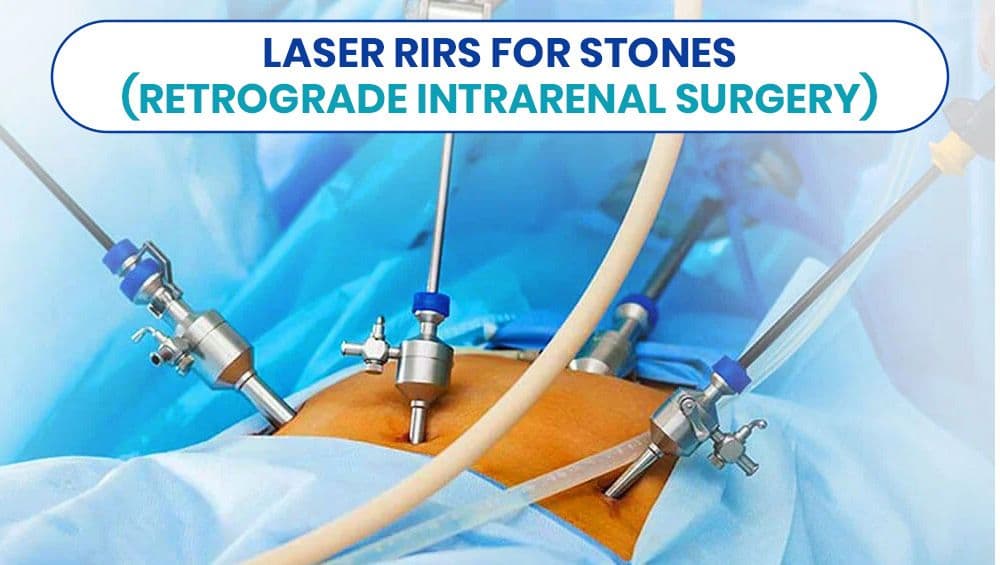
Kidney stones may strike at any time with sharp pain, anxiety, and tension that disrupt your everyday life. The thought of undergoing surgery frequently increases stress. Thanks to advances in endourological technology, treatment of kidney stones does not have to involve invasive operations or extended recovery. Laser RIRS for Stones (Retrograde Intrarenal Surgery) is a minimally invasive, scarless procedure that extracts kidney stones safely and successfully without skin cuts, sutures, or long hospital stays. Using a thin, flexible scope and high-precision laser energy, endourologists can access even hard-to-reach stones within the renal calyces and pulverize them into fine dust.
What Is Laser RIRS?
Laser RIRS is an endoscopic procedure performed through the body's natural urinary pathway. A flexible video endoscope (ureteroscope) is passed through the urethra into the bladder, up the ureter, and directly into the kidney. Once the stone is visualized on a high-definition screen, a high-power Holmium or Thulium laser fiber is fired through the scope to fragment the stone into fine, dust-like particles. Unlike traditional open or keyhole surgeries, Laser RIRS requires zero external skin cuts. The fine stone dust passes out naturally with urine, while larger fragments are retrieved using microscopic nitinol baskets. In certain cases, a temporary double-J (DJ) stent—a soft, flexible tube—is placed inside the ureter to keep urine flowing smoothly and reduce ureteral swelling post-surgery. Discover why RIRS is best for kidney stones and how it compares to other options.
Why Choose Laser RIRS for Kidney Stones?
Laser RIRS has become a leading option for treating kidney stones due to its precision, safety profile, and fast recovery timeline. It is particularly advantageous for:
- Stones located deep within the lower pole calyx or upper ureter
- Complex, multiple, or recurrent kidney stones
- Patients with bleeding disorders or high BMI where open access is risky
- Hard stones that fail to break with shockwave lithotripsy (ESWL)
Read about the success rate of RIRS in complex kidney stones.
Laser RIRS vs. Conventional Open Surgery
- Surgical Access: Laser RIRS uses natural urinary pathways (scarless), whereas conventional surgery requires a large flank incision (7 to 10 cm).
- Tissue Trauma & Pain: RIRS causes minimal tissue disruption with mild post-op discomfort. Conventional surgery involves cutting abdominal muscles, causing moderate to severe incisional pain.
- Hospital Stay: RIRS is performed as a daycare procedure or 24-hour hospital stay, compared to 4 to 7 days for open surgery.
- Recovery Timeline: RIRS patients return to normal activities within 2 to 3 days. Conventional surgery requires 4 to 6 weeks of strict rest. Read can I walk after RIRS surgery and post-surgery recovery.
- Infection Risk: Wound infection risk is virtually zero for RIRS, but significantly higher for large open surgical wounds.
Read our full comparison on RIRS vs open surgery for kidney stones.
Step-by-Step Process of Laser RIRS
- Pre-Procedure Evaluation: Pre-operative diagnostic imaging (such as a non-contrast CT KUB) determines stone size, location, and Hounsfield Unit density. Routine blood and urine tests verify patient safety under anesthesia. Read about the role of ultrasound and CT scan in diagnosing kidney stones.
- The Endoscopic Procedure: Under general or spinal anesthesia, the flexible scope is gently navigated through the natural urinary path. The laser pulverizes the stone into dust or small fragments, which are extracted or left to flush out naturally.
- Post-Surgery Discharge: Because no incisions are made, recovery is rapid. Patients eat, walk, and are discharged the same day or within 24 hours. Mild, temporary burning during urination is easily managed with prescribed medications.
Advantages of Laser RIRS
- Zero External Incisions: Leaves no visible scars or skin cuts.
- Minimal Intraoperative Bleeding: Maginified visual clarity minimizes tissue trauma.
- Rapid Physical Recovery: Most patients return to light work within 48 to 72 hours.
- High Stone Clearance: Digital flexible scope maneuvering allows comprehensive stone clearance in hard-to-reach calyces.
- High Precision: Works effectively on hard stone compositions (like calcium oxalate monohydrate or cystine). Read about the 4 different types of kidney stones.
Post-Procedure Recovery and Aftercare
Recovery after Laser RIRS is smooth and predictable:
- Hydration: Drink 2.5 to 3 liters of water daily to help flush out residual stone dust. Learn why hydration is necessary for kidney health.
- Medication Compliance: Complete prescribed oral antibiotics and alpha-blockers to soothe ureteral spasms.
- Stent Care: If a temporary double-J (DJ) stent is placed, it is typically removed in a quick, outpatient procedure after 1 to 2 weeks.
- Follow-Up Evaluation: Post-procedure ultrasound imaging verifies complete stone-free status.
- Dietary Management: Follow the right diet for kidney stones by reducing sodium and animal protein to prevent new stones from forming.
Expert Endourological Care in Gurgaon
For specialized endourological evaluation and scarless laser stone removal in Gurgaon and Delhi NCR, consult Dr. Deepanshu Gupta. With over 15 years of surgical experience and thousands of successful endourological procedures, Dr. Gupta provides tailored, patient-centered care for complete recovery.
Frequently Asked Questions
Is Laser RIRS painful?
No. Laser RIRS is performed under general or spinal anesthesia, ensuring you feel no pain during the procedure. Post-operative discomfort is mild and easily managed with prescribed analgesics.
How long does it take to recover after Laser RIRS?
Most patients are discharged within 24 hours and can resume normal light daily activities and desk work within 2 to 3 days.
Can Laser RIRS remove large or multiple kidney stones?
Yes. Laser RIRS is effective for stones up to 2 cm and can treat multiple stones located across different calyces during the same session. Read our full guide on RIRS vs PCNL vs ESWL: which is the best treatment for kidney stones.
Is an internal DJ stent always necessary after RIRS?
Not always, but a temporary DJ stent is frequently placed for 1 to 2 weeks to ensure smooth urine drainage, prevent ureteral spasms, and allow the ureter to heal without obstruction.
Have Questions About This Topic?
Get a personalized consultation at Cure Stone Hospital, Sector 52, Gurgaon.
Book Consultation