Dialysis Patients with Kidney Stones: What You Must Know
Managing kidney disease is already a complex problem to solve. Combine that with kidney stones, and things get more complicated, particularly for patients on dialysis. Dialysis patients often have to navigate additional challenges for stone management and treatment. Stones can be quite bothersome and, if poorly managed, could lead to other complications.
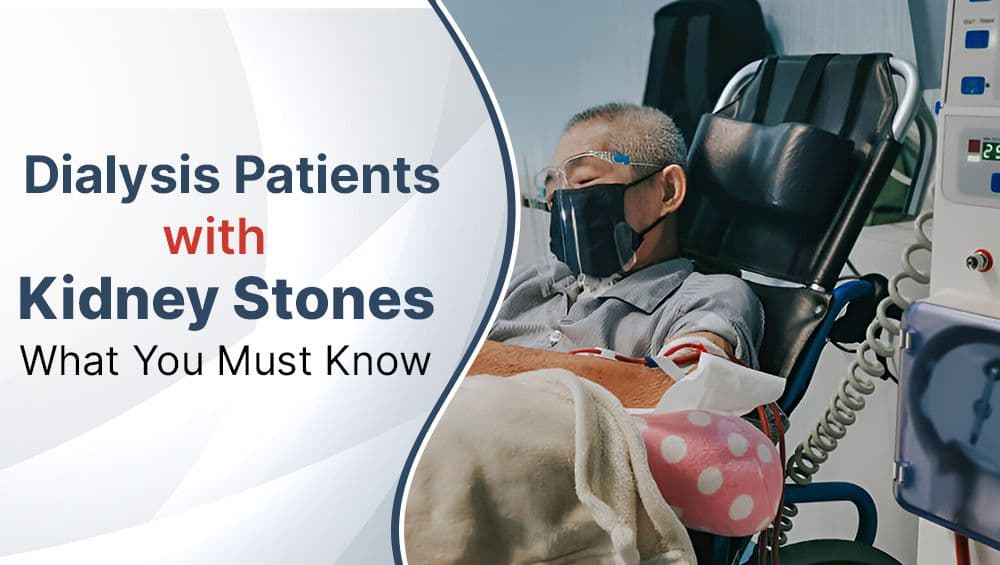
Managing End-Stage Renal Disease (ESRD) or severe Chronic Kidney Disease (CKD) on dialysis requires careful clinical monitoring. When kidney stones (renal calculi) develop in patients undergoing hemodialysis or peritoneal dialysis, treatment becomes significantly more complex.
Even in individuals with minimal or no residual urine output, mineral crystallization, metabolic imbalances, and localized infections can still lead to stone formation inside the kidneys or urinary tract.
In this guide, we explore why kidney stones occur in dialysis patients, how to spot subtle warning signs, accurate diagnostic methods, and safe, specialized treatment strategies.
Can Dialysis Patients Get Kidney Stones?
Yes. While dialysis replaces critical filtration functions of the kidneys, it does not entirely eliminate the biological risk of stone formation:
- Patients with Residual Urine Output: Individuals who still produce small amounts of urine remain vulnerable to mineral precipitation and stone growth within the urinary tract.
- Anuric Patients (Zero Urine Output): Even without active urine flow, stagnant fluid, accumulated mineral deposits, altered metabolic pathways, or persistent bacterial colonizations can trigger stone matrix formation in the renal pelvis.
Primary Causes of Kidney Stones in Dialysis Patients
The underlying drivers of stone formation in patients on dialysis differ from those with normal kidney function:
1. Mineral and Bone Disorder (CKD-MBD)
Severe renal impairment disrupts the balance of calcium, phosphate, parathyroid hormone (PTH), and uric acid in the bloodstream, predisposing patients to rapid mineral crystallization.
2. Use of Calcium-Based Phosphate Binders
Phosphate binders containing calcium are routinely prescribed to manage high blood phosphate levels in ESRD. However, if unmonitored, they can increase calcium loads and elevate stone risk.
3. Recurrent Infections (Struvite Stones)
Chronic urinary tract infections (UTIs) caused by urease-producing bacteria can lead to the formation of struvite stones (infection stones), which can rapidly enlarge within the renal collecting system.
4. Low Fluid Turnover and Stagnation
A lack of consistent fluid flushing allows micro-crystals and cell debris to settle and aggregate into larger stone structures over time.
Symptoms to Watch For in Dialysis Patients
In patients with reduced or absent urine output, classic signs of kidney stone pain (renal colic) may present differently or subtly:
- Persistent, deep flank or lower back discomfort.
- Unexplained fever, chills, or systemic signs of infection.
- Visible blood in urine (hematuria) or dark-colored discharge in patients who still void.
- Unexplained nausea, persistent vomiting, or sudden lethargy.
- Difficulty or burning during urination (dysuria).
Because symptoms can be vague, regular diagnostic imaging is crucial for timely detection.
Diagnostic Methods for Stone Detection in CKD & Dialysis
Accurate diagnosis is necessary to evaluate stone size, density, and impact on remaining kidney architecture:
- Renal Ultrasound: The safest first-line imaging modality for kidney patients because it involves zero ionizing radiation and no contrast dyes.
- Non-Contrast CT Scan (NCCT KUB): Provides gold-standard precision regarding stone dimensions, hardness, and precise anatomical localization without requiring nephrotoxic IV contrast.
- Blood Chemistry Panels: Monitors serum calcium, phosphate, electrolytes, and uric acid levels.
Safe Treatment Options for Dialysis Patients
Surgical interventions for dialysis patients require tailored anesthetic planning, careful fluid balancing, and meticulous surgical execution.
1. Retrograde Intrarenal Surgery (RIRS)
For small to moderate stones, RIRS is a 100% incision-free, endoscopic procedure. A ultra-thin flexible scope is guided through natural urinary passages to pulverize the stone with high-precision lasers without making external cuts.
2. Advanced FANS-RIRS (Suction Laser Surgery)
Upgraded FANS-RIRS incorporates active vacuum suction, continuously clearing fluid and stone dust in real time. This keeps fluid pressure inside the kidney very low, drastically reducing post-operative infection risks and fever. Learn more in our detailed guide to FANS-RIRS suction laser surgery.
3. Percutaneous Nephrolithotomy (PCNL / Mini-PCNL)
For large, dense, or complex stones in dialysis patients, keyhole PCNL or Mini-PCNL provides direct access through a single pinhole tract in the back to break and remove large stone masses efficiently in one session.
4. Stenting and Infection Management
If a stone causes obstruction or localized sepsis, emergency placement of a DJ stent or nephrostomy tube provides immediate urinary drainage and stabilizes the patient prior to stone removal.
Long-Term Management and Prevention Strategies
Preventing recurrent stone formation in dialysis patients involves close collaboration between urologists and nephrologists:
- Strict Dietary and Fluid Protocol: Follow personalized fluid and dietary guidelines provided by your renal dietitian to avoid excess sodium, oxalates, or unbalanced calcium intake. Review core principles on how to avoid kidney stones recurrence.
- Review Phosphate Binders: Consult your nephrologist to adjust calcium-based medications if urinary or serum calcium levels spike.
- Routine Ultrasound Monitoring: Periodic renal scans help identify asymptomatic stones early before they cause obstruction or severe infection.
Consult Top Kidney Stone Specialist Dr. Deepanshu Gupta in Gurgaon
Treating kidney stones in patients with advanced kidney disease or those on dialysis requires specialized clinical judgment and advanced endourological techniques.
Dr. Deepanshu Gupta at Cure Stone is a leading endourologist in Gurgaon and Delhi NCR with extensive clinical experience, having successfully performed over 9,500 endoscopic procedures. Specializing in radiation-free (fluoroscopy-free) RIRS, high-efficiency FANS RIRS suction laser surgery, and Mini-PCNL, Dr. Gupta coordinates closely with nephrology teams to deliver safe, incision-free stone clearance tailored to high-risk patients.
Don't let complex stone disease jeopardize your health. Book a consultation with Cure Stone today to evaluate your diagnostic scans!
Frequently Asked Questions (FAQs)
Can kidney stones cause fever in a dialysis patient?
Yes. A stone blocking any part of the urinary tract can cause stagnant fluid accumulation, leading to severe infection or pyelonephritis. Fever or chills in a dialysis patient with a stone requires immediate emergency medical evaluation.
Is RIRS safe for chronic kidney disease (CKD) and dialysis patients?
Yes. RIRS is 100% incision-free, causes minimal tissue trauma, and avoids IV contrast dyes, making it one of the safest modalities for patients with compromised renal function.
Can a kidney stone be left untreated if the patient does not produce urine?
Not always. Even in anuria, an untreated stone can act as a chronic nidus for infection, abscess formation, or persistent pelvic pain, requiring specialized evaluation by a urologist.
Have Questions About This Topic?
Get a personalized consultation at Cure Stone Hospital, Sector 52, Gurgaon.
Book Consultation