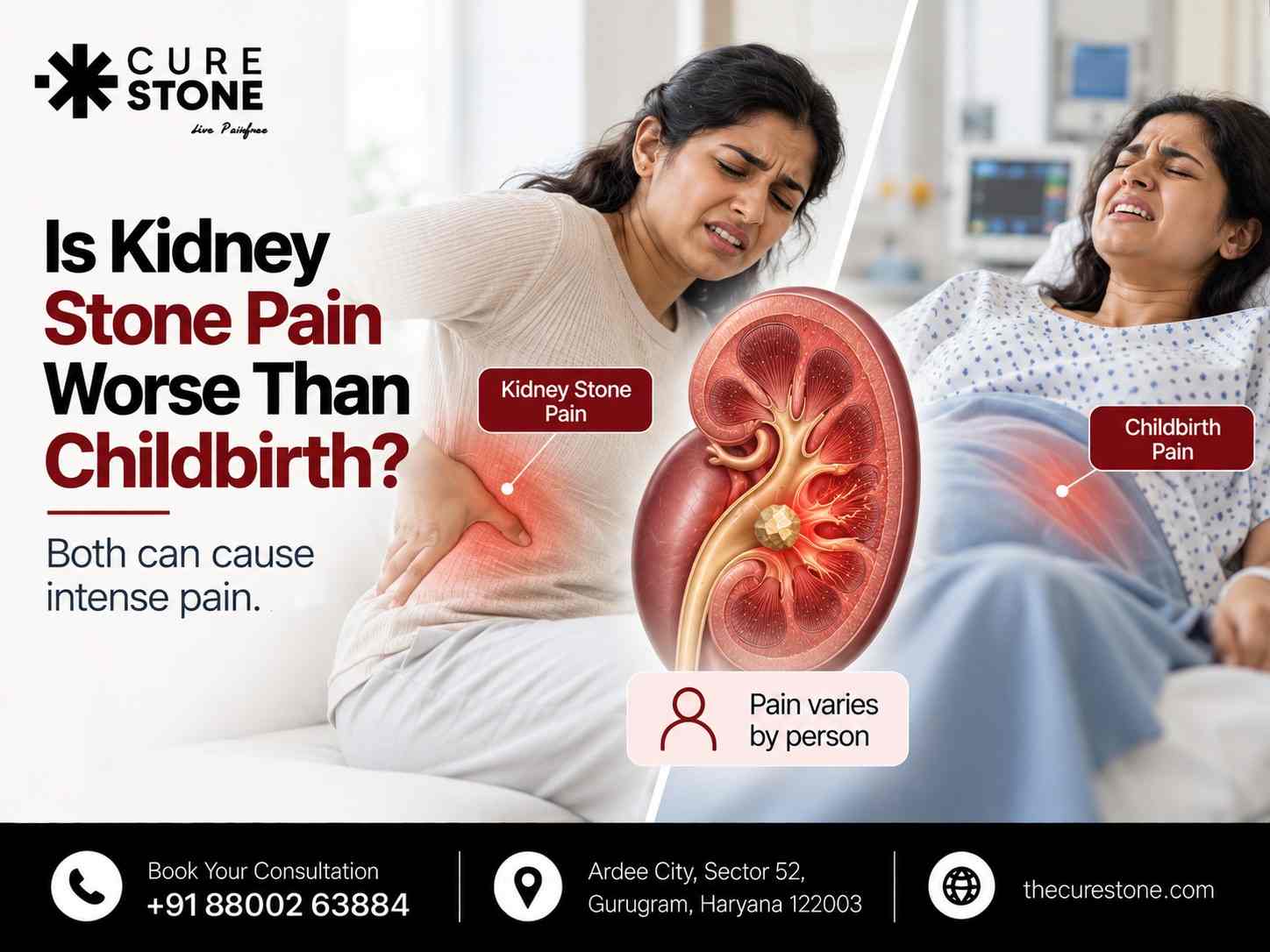
Is Kidney Stone Pain Worse Than Childbirth?
Kidney stone pain and childbirth pain can both be extremely intense, but pain varies from person to person. Learn how kidney stone pain compares with labor pain, what causes the severe pain, and when medical care is needed.
It is one of the most argued-about comparisons in medicine, usually settled by whoever in the room is shouting loudest. But there is actual research on it, and the finding is not what most people expect.
A study published in the Journal of Pain Research asked patients with CT-confirmed ureteric stones to rate their pain, and specifically asked women who had given birth to compare the two directly.
Among the women who had experienced both, 63.3 percent said the kidney stone was more painful than childbirth. A further 15.7 percent rated the two as similar. Only 21 percent said childbirth was worse.
So among women who have been through both, roughly four out of five found the kidney stone at least as bad as giving birth.
The Part That Makes Men Look Foolish
The same study asked men with kidney stones to guess how their pain compared with childbirth.
Most of them assumed childbirth would be worse. Forty percent imagined their renal colic was less painful than labour, and another 23.4 percent thought it was about the same. In total, around 63 percent of men assumed childbirth was worse or equal.
Women who had actually experienced both said the opposite.
Both groups agreed on one thing. 88.9 percent of the men and 78.2 percent of the women said their kidney stone was the worst pain they had ever experienced in their lives.
Before Anyone Gets Carried Away
Two honest caveats, because this is exactly the kind of statistic that gets misused.
The sample was small. Only 19 women in the study had experienced both. That is enough to be interesting and not enough to be definitive.
Pain is not a competition. The two experiences are so different in nature, duration, and context that ranking them misses the point. A woman who says her stone was worse is not saying childbirth was easy, and nobody should use this article to tell a woman anything about her own labour.
What the finding is genuinely useful for is something else entirely, which I will come to at the end.
Why Renal Colic Is So Uniquely Awful
If you have had a stone, this will explain why it felt the way it did.
No position relieves it. This is the single cruellest feature. With most severe pain, the body finds something that helps. Lying still, curling up, shifting position. With renal colic, nothing works. Patients pace, roll on the floor, and cannot sit still, which is why doctors sometimes recognise a stone from the waiting room.
It arrives with no warning. Labour builds. Renal colic goes from nothing to maximum in minutes, often at 3am, with no preparation at all.
There is no known endpoint. A woman in labour knows roughly how long this could last and that it ends. A patient with renal colic has no idea whether this lasts twenty minutes or six hours, or whether it will return tomorrow.
There is no purpose. This matters more than people assume. Pain with meaning is experienced differently from pain without it. Labour produces a child. Renal colic produces nothing except a stone in a strainer.
There is no support system. Labour comes with a birth plan, a hospital, a midwife, a partner, and often an anaesthetist. Kidney stone pain comes with you, alone, googling on your phone while vomiting.
Nausea and vomiting travel with it. The kidneys and gut share nerve pathways, so severe renal colic frequently comes with vomiting, which stops you keeping down the painkillers.
Our guides on what is the most painful stage of kidney stones and where you feel kidney stone pain explain the mechanism in more detail.
Why the Study Authors Bothered
The researchers were not settling a pub argument. They made a specific clinical point.
When a woman goes into labour, there is an entire system built around managing her pain. Anaesthetists, epidurals, staff who expect severe pain and treat it aggressively.
When a patient arrives in an emergency department with renal colic, the pain is frequently underestimated and undertreated. It is "just a stone." They wait. They are given something mild. They are left in a corridor.
That is the real argument in this research, and it is why the comparison is worth making at all.
If you have ever been sent home from a hospital with inadequate pain relief for a stone, that study is on your side.
The Bit That Actually Matters Clinically
Here is the part that most articles on this topic leave out, and it is the most important thing on this page.
How much a stone hurts tells you almost nothing about how dangerous it is.
A 3mm stone lodged at a narrow point in the ureter can produce genuinely unbearable pain and then pass on its own in a week with no lasting harm.
A 3cm staghorn stone filling an entire kidney can cause no pain whatsoever while quietly destroying that kidney's function over months.
Pain comes from obstruction and pressure, not from the stone itself. So the patients I worry about most are frequently not the ones screaming in casualty. They are the ones who never had a bad episode and turn up years later with a kidney that has thinned to nothing.
See how big kidney stones can get, can kidney stones cause permanent kidney damage, and what happens if you do not remove kidney stones.
So do not use pain as your measure of seriousness. Use imaging.
When Pain Does Mean Emergency
Severity alone is not the alarm. These are:
- Fever or chills with the pain. An infected obstructed kidney is a surgical emergency and can deteriorate within hours.
- Vomiting that prevents you keeping down fluids or tablets.
- Passing little or no urine.
- Pain not controlled by prescribed medication.
- Only one functioning kidney, a transplant, or existing kidney disease.
- Pregnancy, where assessment and treatment need specialist handling. See kidney stones in pregnancy.
See how to know when a kidney stone is serious.
What Actually Helps the Pain
Anti-inflammatory medication generally works better than plain paracetamol for renal colic, because it reduces the swelling and pressure driving the pain rather than only the pain signal. It is not suitable for everyone, particularly in kidney impairment, ulcer disease, or pregnancy.
Heat applied to the flank relaxes the muscle spasm and helps while medication takes effect. Steady hydration helps overall, though forcing large volumes during an acute attack can worsen the pain by raising pressure behind the blockage.
For stones in the lower ureter, an alpha blocker can improve the chance of passage. That is a prescription decision.
See how to manage pain during a kidney stone attack and why hydration is necessary for kidney health.
Making Sure It Does Not Happen Again
The people who most want to avoid a second episode are the ones who have had a first.
Roughly half of stone formers develop another stone within five to ten years when the underlying cause is never identified. Finding it means keeping the stone for composition analysis and, for anyone with more than one episode, a metabolic evaluation of what your urine is doing across a full day. See what to expect during your kidney stone tests and how to avoid kidney stone recurrence.
If a stone needs removing, RIRS clears it through the natural urinary passage with no cut and no scar. Our kidney stone checker gives a quick indication of what your size and location typically require, and our kidney stone treatment page sets out the options.
If you have had an episode like this, book a consultation with Dr. Deepanshu Gupta rather than waiting for the next one.
Frequently Asked Questions
Is kidney stone pain worse than childbirth?
In a published study of women who had experienced both, 63.3 percent said the kidney stone was more painful, 15.7 percent found them similar, and 21 percent said childbirth was worse. The sample was small, but it suggests renal colic is at least comparable for most women who have been through both.
Why is kidney stone pain so severe?
Because a stone obstructing the ureter causes pressure to build inside the kidney while the ureter spasms around it. Unlike most severe pain, no position or movement relieves it, and it arrives suddenly with no warning or endpoint.
Do men underestimate childbirth pain?
In the same study, most men with kidney stones assumed childbirth would be worse than or equal to their own pain. Women who had experienced both largely disagreed.
Does a bigger kidney stone hurt more?
No, and this is one of the most important misconceptions. Pain comes from obstruction, not from stone size. A small stone wedged in a narrow point can be agonising while a very large stone sitting in the kidney can cause no pain at all.
Is severe pain a sign the stone is dangerous?
Not by itself. Severity tells you about obstruction and location, not about risk. Fever, inability to pass urine, persistent vomiting, and uncontrolled pain are the genuine emergency signs.
What is the fastest way to relieve kidney stone pain?
An anti-inflammatory painkiller taken as directed, combined with heat applied to the affected side, gives the quickest relief for most people. Anti-inflammatories are not suitable for everyone, so follow the advice you were given.
How long does a kidney stone attack last?
Individual episodes typically last from twenty minutes to a few hours and come in waves. The overall episode can continue intermittently for days or weeks until the stone passes or is removed.
Can kidney stone pain be worse at night?
Many patients find it is. There is less distraction, lying flat alters pressure within the kidney, and urine becomes more concentrated overnight. See why kidney stones hurt more at night.
References
- Miah S, Gunner C, Clayton L, Venugopal S, Boucher NR, Parys B. Renal colic and childbirth pain: female experience versus male perception. Journal of Pain Research. 2017. https://www.tandfonline.com/doi/full/10.2147/JPR.S135901
Have Questions About This Topic?
Get a personalized consultation at Cure Stone Hospital, Sector 52, Gurgaon.
Book Consultation