PUJ Calculus vs PUJ Obstruction: What Does Your Scan Report Mean?
A PUJ calculus is a stone near the kidney’s drainage outlet; PUJ obstruction means impaired flow there. Learn how to read the difference on your scan.

A scan report that mentions “PUJ calculus” or “PUJ obstruction” is describing the same small area near the kidney, but not necessarily the same problem. It is easy to read the two phrases as interchangeable. They are not.
Short answer: a PUJ calculus is a stone at the pelviureteric junction, where urine leaves the kidney and enters the ureter. PUJ obstruction means urine is not draining normally through that junction. A stone can temporarily block it, while a narrowing or other structural problem can also obstruct it. Some people have both. The scan images, symptoms and kidney function help a urologist work out which explanation fits.
Where is the PUJ, and is it the same as the UPJ?
The renal pelvis collects urine from the kidney and narrows into the ureter, the tube that carries urine to the bladder. The meeting point is called the pelviureteric junction (PUJ). Some reports use ureteropelvic junction (UPJ); it names the same location. “Right” or “left” tells you which kidney is involved.
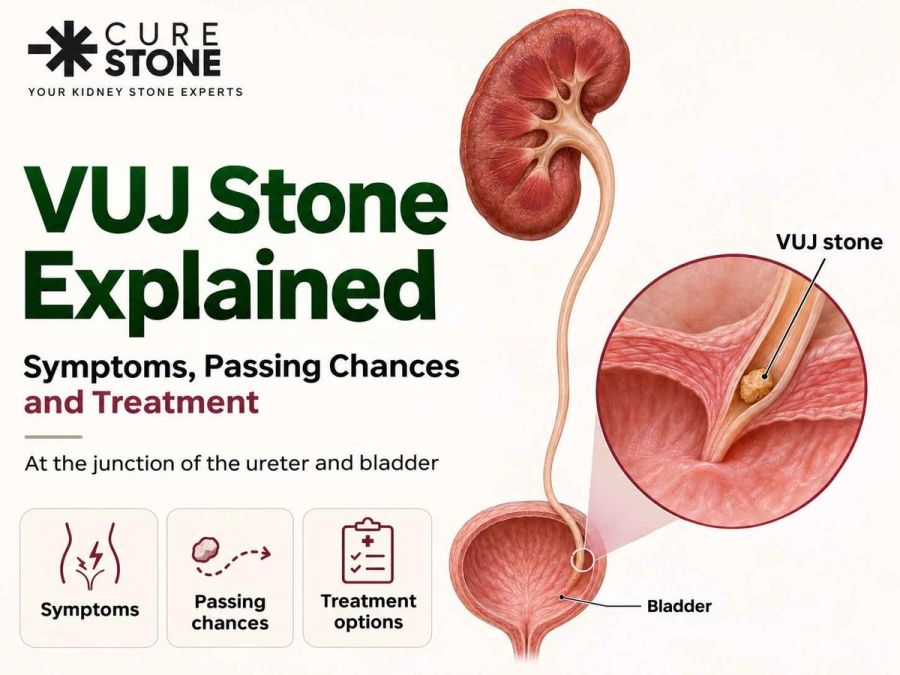
This is not the VUJ or UVJ, which is at the other end of the ureter where it enters the bladder.
For the lower junction, see our VUJ calculus guide.
What does “PUJ calculus” mean on a scan?
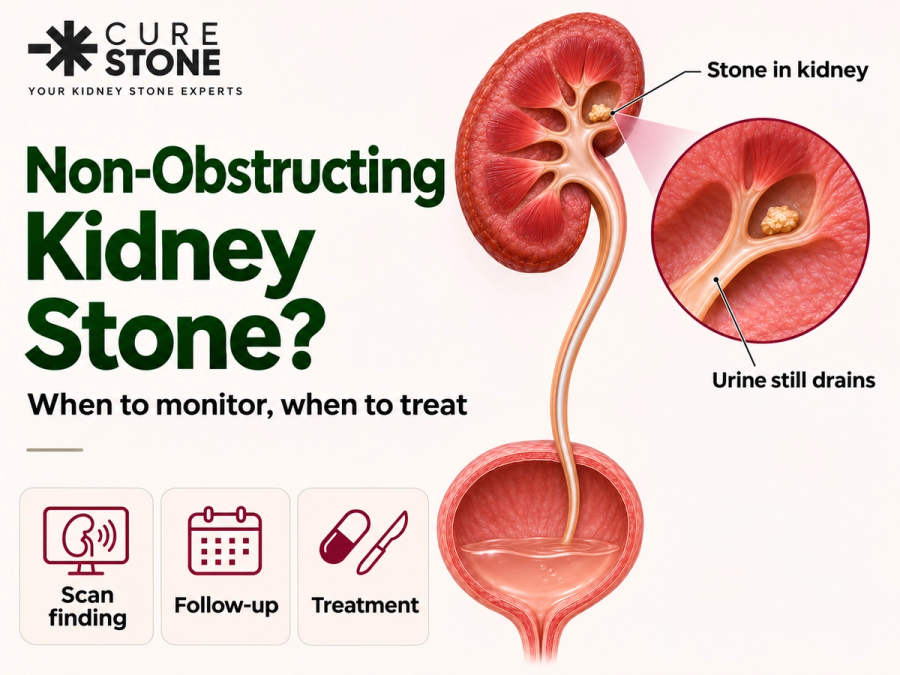
“Calculus” means a stone. A report saying “right PUJ calculus” describes a stone seen at or very near the right kidney’s drainage outlet. Its size, exact position and whether urine is backing up are separate findings. A PUJ stone may cause pain or swelling of the kidney, but the phrase alone does not tell you how serious the blockage is or whether the stone will pass.
Ask whether the report also mentions hydronephrosis, which means dilatation of the kidney’s collecting system. A stone at this junction may be the reason for that dilatation, but your urologist should check the images rather than infer the cause from one line.
What does “PUJ obstruction” or “PUJO” mean?
PUJ obstruction describes impaired urine flow from the renal pelvis into the upper ureter. Sometimes the junction is narrow from an underlying structural issue; sometimes a blood vessel crossing nearby contributes. Scarring or a stone can also be involved. The term describes a drainage problem, not automatically a stone.
A report may say “suspected PUJO” because the collecting system looks enlarged. That is a reason for further assessment, not proof that a permanent narrowing exists. Your doctor may compare earlier scans, assess whether a stone is present and decide whether a test of drainage and kidney function is needed.
For the wider condition and its longer-term treatment, read our PUJ obstruction guide.
Can a PUJ stone and PUJ obstruction happen together?
Yes. A stone can physically block the junction and cause temporary hydronephrosis. An underlying narrowing can also slow drainage and coexist with stones. After a stone passes or is treated, persistent dilatation may prompt the urologist to check whether there is a separate outflow problem. One scan cannot always settle that question.
This distinction matters because treating a stone and correcting a lasting structural obstruction are different decisions. Neither diagnosis should be assumed just because the word “PUJ” appears.
Which report details should you bring to a consultation?
- The exact wording and the side affected: “PUJ calculus,” “suspected PUJO,” “hydronephrosis,” or another term.
- The stone measurement and scan images, not only the typed summary. Size and position influence the plan.
- Any previous ultrasound or CT reports, so the clinician can see whether dilatation is new, changing or longstanding.
- Your symptoms, including pain, fever, vomiting, urinary changes and whether you have one functioning kidney.
Ultrasound can show dilatation and sometimes a stone at the PUJ. CT may better define a stone and anatomy when appropriate. If a lasting PUJ drainage problem is suspected, a functional renal scan may help assess drainage and the contribution of each kidney. The choice of test depends on your case; not everyone needs every scan.
For common ultrasound terms, read our USG report guide.
How is the treatment plan different?
For a PUJ calculus, the urologist considers stone size, position, symptoms, infection, kidney function and whether urine is obstructed. Observation may be possible in selected uncomplicated cases. A stone that is unlikely to pass, keeps causing pain or blocks drainage may need a procedure. The best option cannot be chosen from the word “PUJ” alone.
For a confirmed, persistent PUJ obstruction, the question is whether drainage and kidney function are affected enough to need treatment. Some patients are monitored; others may need a procedure to correct the narrowing. If a stone and structural obstruction coexist, the plan may need to address both.
Fever or chills with a suspected obstructing stone, very little urine, uncontrolled pain or persistent vomiting needs prompt medical assessment. An infected obstructed kidney is an emergency; infection and drainage take priority before definitive stone treatment.
Frequently asked questions
Does “PUJ calculus” mean I have permanent PUJ obstruction?
No. It identifies a stone at that location. The stone may cause a temporary blockage, but a separate persistent narrowing needs its own assessment.
Does hydronephrosis prove PUJO?
No. Hydronephrosis describes dilatation, not its cause. A stone, a narrowing or another issue can affect drainage. The images, symptoms and sometimes further tests help clarify why it is present.
Is a PUJ calculus the same as a VUJ calculus?
No. PUJ is near the kidney; VUJ is where the ureter reaches the bladder. The position changes the questions your urologist asks about passage and treatment.
Can a PUJ stone pass without surgery?
Some stones pass, but the chance varies with size, position and the presence of obstruction or infection. Ask your urologist for a follow-up plan rather than waiting indefinitely on the basis of a single report.
What should you do next?
Bring the scan images and report to a urologist, especially if the wording is unclear or the kidney is described as swollen. A review should answer two separate questions: is there a stone at the PUJ, and is drainage impaired for a reason that may persist after the stone is gone? Cure Stone’s Gurgaon team can review your imaging and explain the next step for your case.
You can request a Gurgaon consultation here.
This article is general information and cannot diagnose the cause of obstruction from a written report alone.
References
European Association of Urology: 2026 Urolithiasis Guidelines
Have Questions About This Topic?
Get a personalized consultation at Cure Stone Hospital, Sector 52, Gurgaon.
Book Consultation