Laser vs shockwave treatment for kidney stones – Which works better?
Kidney stones are hard, tiny particles that may develop in your kidneys. Sometimes kidney stones remain silent and cause no discomfort, but in other cases they can trigger severe pain, difficulty passing urine or even nausea.
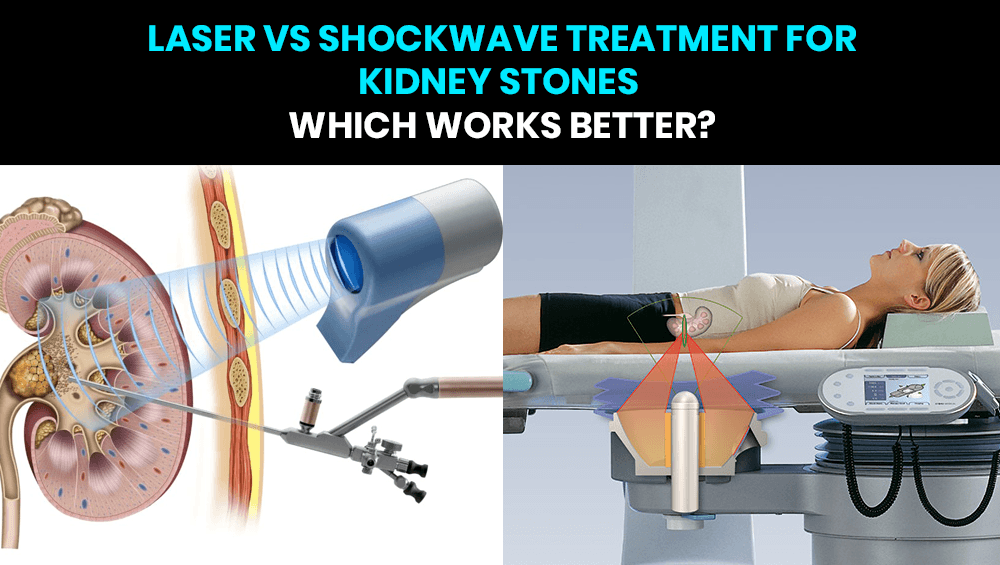
Kidney stones are hard, tiny particles that develop in your kidneys. While some stones remain silent and cause no discomfort, others can trigger severe flank pain, difficulty urinating, or persistent nausea. If you are evaluating options to remove a stone, you have likely come across Laser Treatment (RIRS) and Shockwave Therapy (ESWL). Both are modern, highly effective treatments that eliminate stones without requiring large surgical cuts. Understanding how they compare helps you determine which path leads to the safest, fastest recovery.
Laser Treatment for Kidney Stones (RIRS)
Retrograde Intrarenal Surgery (RIRS) is a minimally invasive endourological procedure performed through the body's natural urinary pathway without any skin cuts.
Step-by-Step Process
- Anesthesia: The patient receives spinal or general anesthesia to remain completely comfortable during the procedure.
- Scope Insertion: A thin, highly flexible ureteroscope is gently guided through the urethra and bladder directly into the kidney.
- Stone Location: The urologist pinpoints the exact position of the stone using a tiny camera on the scope.
- Laser Fragmentation: A Holmium or Thulium laser fiber delivers precise energy pulses to break the stone into fine dust or small fragments.
- Stone Removal: Microscopic dust passes out naturally with urine. Larger fragments are retrieved using specialized mini-baskets.
- Stent Placement: A temporary double-J (DJ) stent may be placed in the ureter to keep urine flowing smoothly and assist healing.
Pros and Cons of Laser Treatment (RIRS)
- Pros: Highly effective for all stone types, hard densities, and sizes up to 2 cm. It achieves complete stone clearance in a single session and works well even for complex lower-pole stones without external cuts. Discover why RIRS is best for kidney stones.
- Cons: Requires general or spinal anesthesia and a brief hospital stay (1 to 2 days). The temporary internal stent may cause mild, temporary urinary irritation. Read about can I walk after RIRS surgery and post-surgery recovery.
Shockwave Therapy for Kidney Stones (ESWL)
Extracorporeal Shock Wave Lithotripsy (ESWL) is a completely non-invasive outpatient treatment that uses acoustic waves to break stones into small pieces.
Step-by-Step Process
- Preparation: The patient lies on a specialized table aligned with a water-filled cushion.
- Sedation: Full anesthesia is rarely required; light sedation or painkillers are provided for comfort.
- Stone Targeting: X-ray or ultrasound imaging pinpoints the exact coordinates of the stone.
- Shockwave Delivery: High-energy sound waves pass harmlessly through skin and tissue to strike the stone.
- Natural Passage: Shattered stone fragments travel down the ureter and pass out in urine over the following days or weeks.
Pros and Cons of Shockwave Therapy (ESWL)
- Pros: Completely non-invasive with zero incisions or scopes. Performed as an outpatient procedure allowing same-day home recovery with minimal initial discomfort. Read more on lithotripsy for kidney stones.
- Cons: Less effective for hard stones (high Hounsfield units) or stones larger than 1.5 cm. Some patients require 2 to 3 sessions to clear the stone completely, and passing fragments later can cause mild colic pain.
Comparative Guidelines by Age Group
- Children: ESWL is frequently preferred as a first-line option because it avoids internal scopes and minimizes anesthesia exposure.
- Young Adults (18–40 Years): Both treatments are effective. The choice depends primarily on stone size, location, and the patient's schedule.
- Middle-Aged Adults (40–60 Years): Laser treatment (RIRS) is often favored for larger or harder stones to ensure complete stone clearance in one setting.
- Elderly Patients (60+ Years): Evaluated case-by-case. ESWL may be safer if underlying cardiac or pulmonary conditions increase general anesthesia risks.
Safety and Risk Comparison
- Laser Treatment (RIRS): Safe and highly controlled. Rare risks include temporary burning during urination from the stent, minor urinary infection, or transient ureteral irritation. Read are there any disadvantages of RIRS.
- Shockwave Therapy (ESWL): Safe and non-surgical. Temporary side effects include mild blood in urine or localized skin bruising. It is not suitable for pregnant women, patients with bleeding disorders, or very large, hard stones.
Frequently Asked Questions
Which procedure causes less pain?
ESWL is virtually painless during the procedure, but passing stone fragments over subsequent days can cause mild colic. RIRS is performed under anesthesia so you feel no pain during surgery, with mild, temporary discomfort occurring only if a stent is placed.
Can children undergo laser treatment?
Yes, pediatric RIRS is safe when performed using mini-endoscopes. However, urologists typically evaluate whether non-invasive ESWL can resolve the stone first.
Can kidney stones return after RIRS or ESWL?
Yes. Neither treatment alters your underlying metabolism. Maintaining daily fluid intake (2.5 to 3 liters) and following dietary guidance based on your stone composition are essential to prevent recurrence. Read our guide on how to avoid kidney stone recurrence.
Expert Decision Summary
- Choose ESWL if: Your stone is small (under 1.5 cm), relatively soft, located in the upper or middle kidney, and you prefer a non-surgical, outpatient treatment.
- Choose RIRS if: Your stone is larger (up to 2 cm), hard, located in the lower pole of the kidney, or if you want a guaranteed, single-session clearance rate.
For expert urological evaluation and treatment in Gurgaon and Delhi NCR, consult Dr. Deepanshu Gupta. With over 15 years of experience and thousands of successful endourological procedures, Dr. Gupta provides accurate diagnostic evaluations and personalized treatment plans for complete recovery.
Have Questions About This Topic?
Get a personalized consultation at Cure Stone Hospital, Sector 52, Gurgaon.
Book Consultation