Do Roller Coasters Really Help Pass Kidney Stones?
Can riding a roller coaster help a kidney stone pass? Learn what research suggests about amusement rides and kidney stone passage, whether it is safe, and when medical treatment may be needed.
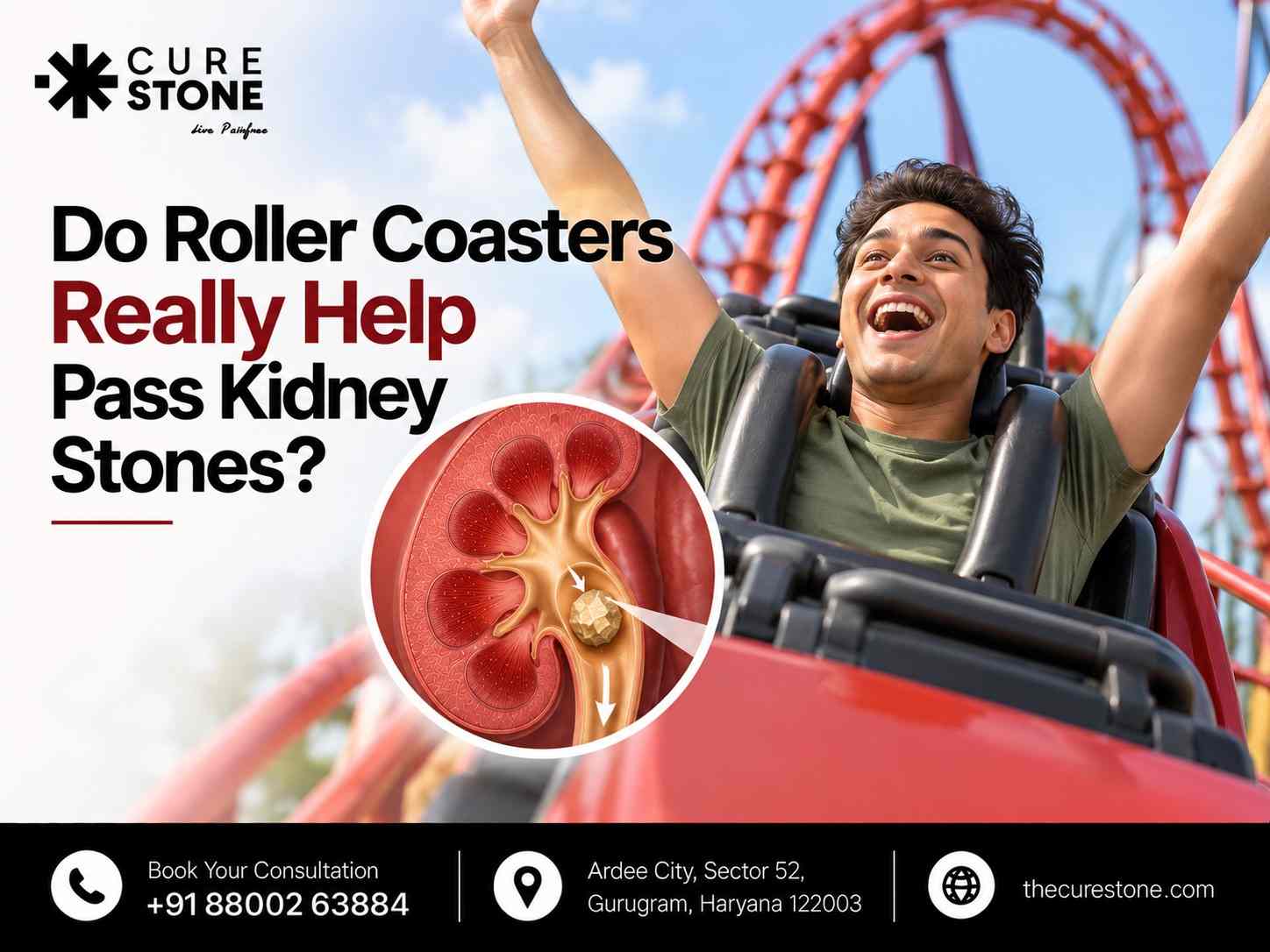
It sounds like an internet joke. It is not. There is a peer-reviewed study on this, published in a medical journal, and the findings are more interesting than most people expect.
Whether it means you should book a theme park trip instead of seeing a urologist is a different question, and the answer to that one is no. Here is what the research actually showed, what it did not show, and who should absolutely not try it.
Where This Came From
A urologist in Michigan noticed something odd. Patients kept telling him they had passed kidney stones while on holiday at Disney World in Florida, and specifically after riding the same roller coaster, Big Thunder Mountain Railroad. One man reported passing a different stone after each of three consecutive rides.
Most doctors would have filed that under coincidence. Dr David Wartinger decided to test it.
What the Study Actually Did
The researchers built a functional silicone model of a kidney's collecting system, based on the CT scan of a real patient. They placed three genuine kidney stones of different sizes inside it, suspended in urine, sealed it, and put it in a backpack held at kidney height between two researchers.
Then they rode Big Thunder Mountain Railroad twenty times.
Sixty individual stone rides were analysed, varying the stone size, its position within the kidney, and where the model sat on the coaster.
The Results
Rear seating: 23 passages out of 36 rides, roughly 64 percent.
Front seating: 4 passages out of 24 rides, roughly 17 percent.
That difference is large and it was consistent. Sitting at the back worked nearly four times better than sitting at the front.
Position within the kidney mattered even more. For rear-seated rides, stones in the upper calyx passed 100 percent of the time. Middle calyx stones passed around 56 percent of the time. Lower calyx stones, the hardest position in real life too, managed around 40 percent.
When the researchers extended the work to around 200 rides using multiple kidney models and 174 stones, rear-seat passage rates rose to nearly 70 percent.
The Detail Everyone Misses
Not every roller coaster worked. This is the part that gets left out of the headlines.
The team also tested Space Mountain and Rock 'n' Roller Coaster. Both failed.
The explanation is that high-speed, high-G-force rides generate forces that pin the stone in place rather than jostling it loose. What appeared to work was a moderate-intensity ride with plenty of vibration, rattling, and quick direction changes, without extreme acceleration.
So "ride a roller coaster" is not the finding. "A specific type of moderate, bumpy ride, sitting at the back" is closer to it.
Now the Honest Caveats
This is where I part company with most articles on this topic.
It was a model, not a patient. A silicone kidney in a backpack is not a human body. It has no surrounding tissue, no muscle tone, no breathing, no peristalsis in the ureter, and no pain response. A real kidney sits cushioned inside a living abdomen and behaves differently.
There has been no randomised trial in actual patients. The study was explicitly described by its own author as supporting anecdotal evidence, not as proof of a treatment.
The stones involved were small. The benefit, if real, applies to stones under roughly 4 to 5 millimetres. Those are precisely the stones that pass on their own in the large majority of cases anyway. See the best treatment for 5mm kidney stones.
It does nothing for the stones that actually matter. A 10mm stone is not going anywhere on a roller coaster. Neither is a staghorn stone. See how big kidney stones can get and what is the best way to remove large kidney stones.
So the fair summary is this. The research is genuine, the mechanism is plausible, and the effect may well be real. But it is a model study describing a small effect on small stones, not a treatment.
The More Interesting Idea Buried Inside It
Wartinger made a suggestion that got less attention than the Disney headlines, and it is the part I find genuinely worth thinking about.
If periodic jostling can dislodge small fragments from the kidney before they grow large enough to obstruct, then the value might be preventive rather than therapeutic. Clearing debris while it is still harmless, rather than waiting until it becomes a 7mm problem.
That idea has not been tested properly in patients. But it fits with something we already know: stones grow where urine sits still, and fragments left behind in the kidney act as seeds for the next stone. See recurring kidney stones and how to avoid kidney stone recurrence.
It is also why FANS RIRS and suction techniques that actively clear fragments during surgery matter more than most patients realise.
Who Should Not Try This
If you are tempted, these situations make it a genuinely bad idea.
- An obstructing stone. If urine is not draining, shaking the stone around risks worsening the obstruction and the pain, not clearing it.
- Any sign of infection. Fever with flank pain means a possibly infected obstructed kidney, which is a surgical emergency. See how to know when a kidney stone is serious.
- A stone above about 5mm. It will not pass and you risk lodging it somewhere worse.
- A DJ stent in place. Vibration worsens stent symptoms and bleeding considerably.
- Recent stone surgery.
- Pregnancy. See kidney stones in pregnancy.
- Heart conditions, uncontrolled blood pressure, spinal problems, or any of the standard contraindications printed on the ride itself.
- A single functioning kidney or existing kidney disease.
And the obvious practical one: passing a stone is often extremely painful, and the middle of a theme park is a poor place for it to happen.
What I Would Actually Tell a Patient
If you have a confirmed small stone in the upper part of your kidney, no obstruction, no infection, and you happen to be going to a theme park anyway, riding a moderate coaster in the back seat is harmless and might help. There is no reason to avoid it.
What I would not do is plan a trip around it, delay assessment because of it, or assume it replaces anything.
The things that genuinely move small stones are less entertaining and far more reliable: steady hydration, appropriate pain control, and where the stone sits in the lower ureter, an alpha blocker to relax the ureteric muscle. See how much water you should drink to prevent kidney stones, does more walking help pass kidney stones, and non-surgical treatment options for small kidney stones.
And if the stone is too big to pass, no amount of shaking will change that. RIRS removes it through the natural urinary passage with no cut and no scar. Our kidney stone checker gives a quick indication of what your size and location typically require, and our kidney stone treatment page sets out the options.
For a proper assessment of whether your stone will pass or needs treating, book a consultation with Dr. Deepanshu Gupta.
Frequently Asked Questions
Do roller coasters really help pass kidney stones?
A published model study found that a silicone kidney containing real stones passed them around 64 percent of the time when seated at the rear of a moderate-intensity roller coaster, compared with around 17 percent at the front. It was a model rather than a patient trial, so the finding is suggestive rather than proven.
Which seat on the roller coaster works best?
The rear. In the study, rear seating produced roughly four times the passage rate of front seating, thought to be because of greater vibration and jostling without extreme acceleration.
Do all roller coasters work?
No. The researchers tested two faster, higher-intensity rides and neither produced the effect. High G-forces appear to pin the stone in place rather than dislodging it. Only the moderate-intensity ride worked.
What size stone could this help?
Small ones, generally under 4 to 5 millimetres. Those are also the stones most likely to pass on their own regardless. Larger stones will not be moved by any ride.
Is it safe to ride a roller coaster with a kidney stone?
Not always. Avoid it with an obstructing stone, any sign of infection, a stone above roughly 5mm, a stent in place, recent surgery, pregnancy, or a single functioning kidney. The standard ride restrictions for heart, blood pressure, and spinal conditions also apply.
Can I ride a roller coaster with a DJ stent?
It is best avoided. Vibration worsens stent discomfort and bleeding, and there is no benefit to offset it.
Has this been tested in actual patients?
Not in a randomised trial. The evidence comes from a functional kidney model plus anecdotal patient reports that prompted the study in the first place.
Should I plan a trip to pass my kidney stone?
No. If you are going anyway and your stone is small and not obstructing, there is no reason to avoid the ride. But it is not a treatment, and it should not delay proper assessment of a stone that needs attention.
References
- Mitchell MA, Wartinger DD. Validation of a Functional Pyelocalyceal Renal Model for the Evaluation of Renal Calculi Passage While Riding a Roller Coaster. Journal of the American Osteopathic Association. 2016;116(10):647-652. doi:10.7556/jaoa.2016.128
Have Questions About This Topic?
Get a personalized consultation at Cure Stone Hospital, Sector 52, Gurgaon.
Book Consultation