Can Obesity Increase the Risk of Kidney Stones?
Obesity may increase the risk of developing kidney stones by affecting urine chemistry and metabolic health. Learn how excess weight can contribute to stone formation and what may help reduce your risk.
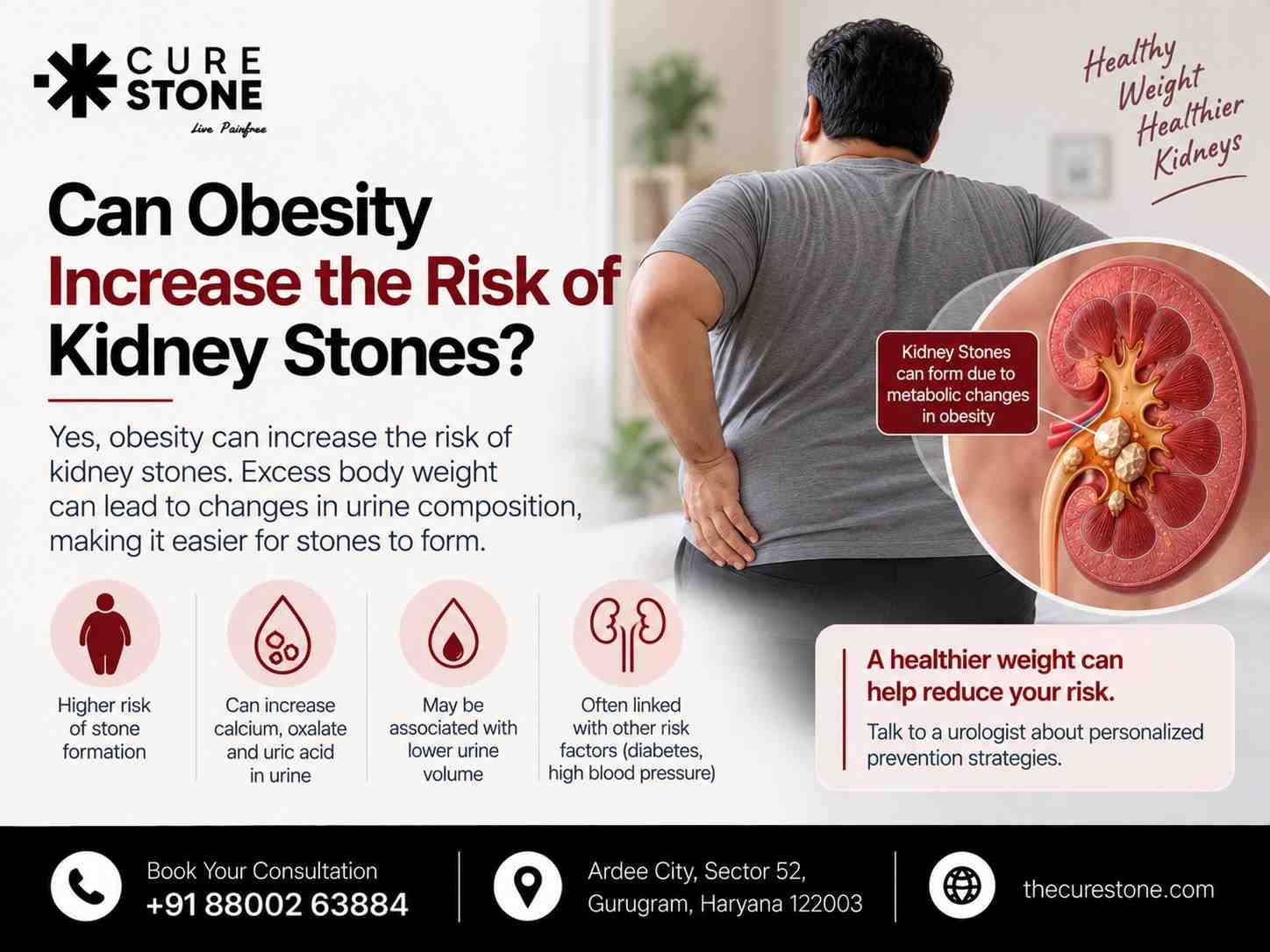
Obesity is one of the strongest and most consistently proven risk factors for kidney stones, and it is also one of the least discussed with patients. Most people leave a stone consultation having been told to drink more water and eat less spinach. Very few are told that body weight is doing more to drive their stone risk than anything on their plate.
The link is not vague. Higher body weight changes urine chemistry in specific, measurable ways, and weight gain over time raises stone risk independently of what you eat. It also makes stones harder to detect and, in some cases, harder to treat.
Here is what is actually happening and what can be done about it.
What Obesity Does to Your Urine
Three changes matter.
Urine becomes more acidic. This is the most important one. Insulin resistance, which travels with excess body weight, impairs the kidney's ability to produce ammonia, one of the main ways your body neutralises acid in urine. Less ammonia means persistently more acidic urine.
Uric acid is poorly soluble in acidic urine and crystallises out of it readily. So someone can be excreting an entirely normal amount of uric acid and still form uric acid stones, purely because of the pH of the urine it is dissolved in. See uric acid stones, complications and treatment.
This is why the type of stone shifts with body weight. Uric acid stones account for a modest share of stones overall but a much larger share in people with obesity and metabolic syndrome.
More stone-forming material is excreted. Studies measuring 24 hour urine chemistry consistently show higher excretion of calcium, oxalate, uric acid, and sodium with increasing body weight. Larger body size means a larger dietary and metabolic load passing through the kidneys.
Citrate tends to be lower. Citrate is your body's natural stone inhibitor, binding calcium in urine so it cannot bind oxalate. Acidic urine causes the kidney to hold on to citrate rather than excrete it, so at exactly the point when more inhibition is needed, less is available.
The result is urine that is more acidic, carries more stone-forming material, and has less natural protection. Our guide on which factors mainly cause kidney stones places this alongside the other causes.
Weight Gain Matters, Not Just Current Weight
Large long-term studies have found that the amount of weight gained over adult life predicts stone risk independently of where you currently sit. Someone who gained a significant amount of weight since their twenties carries higher risk than someone who has been at the same weight throughout, even at a similar current size.
The association has also been found to be stronger in women than in men in several major studies, which runs against the general assumption that stones are primarily a male problem. See what causes kidney stones in women.
The Weight Loss Trap
This is the part that catches people out, and it is genuinely counterintuitive.
High protein, low carbohydrate diets increase stone risk. Ketogenic and similar approaches are popular for weight loss and they work for many people, but they produce a large acid load. That pushes urine pH down further, raises urinary calcium, and lowers citrate. In other words, the diet corrects the underlying problem slowly while worsening the urine chemistry immediately.
If you are already a stone former and starting a high protein diet, that is worth discussing with your urologist rather than discovering the consequence six months later. See the role of diet in kidney stone formation and prevention.
Crash dieting and poor fluid intake compound it. Rapid weight loss with inadequate hydration concentrates urine at the exact moment its chemistry is least favourable.
Some bariatric surgery raises stone risk substantially. This surprises patients, because bariatric surgery is meant to fix the problem. Malabsorptive procedures such as Roux-en-Y gastric bypass alter fat absorption in the gut, and unabsorbed fat binds calcium that would otherwise have bound oxalate. Free oxalate is then absorbed in far larger amounts and delivered to the kidney. This is called enteric hyperoxaluria and it is a well-recognised cause of calcium oxalate stones after bypass surgery.
Restrictive procedures such as sleeve gastrectomy carry considerably less of this risk. Anyone who has had a malabsorptive procedure should be monitored for stone risk regardless of how much weight they have lost. See kidney stones and digestive issues.
So weight loss does reduce stone risk, but the method matters, and some methods raise it in the short term or permanently.
Obesity Makes Stones Harder to Find
There is a practical dimension that rarely gets mentioned.
Ultrasound becomes less reliable with increasing body size, because sound waves attenuate before reaching the kidney. CT remains accurate but requires a higher radiation dose to produce usable images, and some scanners have weight and aperture limits.
The consequence is that stones can be missed or underestimated, and diagnosis can be delayed. If you have symptoms suggesting a stone and an ultrasound comes back clear, that is not always the end of the matter. See the role of ultrasound and CT scan in diagnosing kidney stones.
Obesity Changes Which Treatment Works
Body weight affects the treatment decision more than most patients realise.
Shock wave lithotripsy becomes less effective. ESWL works by focusing shock waves from outside the body onto the stone. The greater the distance from skin to stone, the more energy is lost along the way. Beyond a certain distance, success rates fall substantially, which is why ESWL is often a poor choice in patients with a high body mass index.
Percutaneous surgery becomes technically harder. Creating and maintaining a tract through the flank into the kidney is more difficult when there is a greater thickness of tissue to traverse, and standard instruments can be too short. See Mini PCNL.
RIRS is the least affected by body weight. Because RIRS works through the body's natural urinary passage, the distance from skin to kidney is irrelevant. There is no tract to create and no shock wave to transmit through tissue. For many patients with obesity, this makes it the most reliable option, and it also avoids a wound in a group where wound healing is often slower.
Anaesthesia and positioning need more planning. This is manageable and routine, but it means the procedure should be planned rather than performed as an emergency wherever possible.
Our comparison of RIRS versus PCNL versus ESWL and small versus large kidney stones and which surgery works best cover the wider decision.
What Actually Reduces Your Risk
For someone carrying excess weight, stone prevention and general metabolic health are largely the same project. The measures below help both.
Increase fluid intake deliberately. Target a urine output of at least 2 to 2.5 litres a day, which usually means drinking more than three litres, and more again in hot weather. Body size means a larger solute load, so the fluid requirement is genuinely higher than for a smaller person. See how much water you should drink to prevent kidney stones and why hydration is necessary for kidney health.
Reduce salt. Sodium drives calcium into the urine, and it is usually the highest yield dietary change available. Packaged snacks, pickles, papad, and restaurant food are the main sources.
Choose a sustainable approach to weight rather than an aggressive one. Gradual loss with adequate hydration and moderate protein avoids the urine chemistry problems that come with rapid, high protein approaches.
Keep normal dietary calcium. Cutting calcium is a common mistake. Dietary calcium binds oxalate in the gut so it never reaches the kidney. See can kidney stone patients consume milk and what to eat if you have kidney stones.
Add citrate. Lemon or lime in water provides citrate. For patients with persistently acidic urine, prescribed potassium citrate is considerably more effective.
Stay physically active. Exercise improves insulin sensitivity, which addresses the root mechanism rather than the downstream chemistry. See can exercise help in treating kidney stones and what exercise is good for kidney stones.
Get properly tested rather than guessing. Stone composition analysis and a 24 hour urine study identify exactly which parameter is off in your case. In this group the answer is frequently low urine pH, which is directly treatable. See what to expect during your kidney stone tests, recurring kidney stones, and how to avoid kidney stone recurrence.
The One Piece of Good News
Uric acid stones, the type most associated with obesity and insulin resistance, are the only common stone type that can genuinely be dissolved with medication rather than removed surgically.
Because the problem is urine pH rather than the quantity of uric acid, raising urine pH with potassium citrate can dissolve existing uric acid stones over weeks to months in selected patients and prevent new ones from forming.
That is a real advantage, but it depends entirely on knowing what type of stone you have. Nothing dissolves a calcium stone, and treating one with alkalinising medication achieves nothing while it continues to grow. See the 4 different types of kidney stones.
Obesity also raises the long-term stakes, since it independently contributes to kidney disease and repeated stone obstruction adds to that burden. See kidney stones and the risk of chronic kidney disease.
If you already have a stone, our kidney stone checker gives an indication of what your size and location typically require, and our kidney stone treatment page sets out the options. For an assessment that addresses the metabolic cause rather than only the stone, book a consultation with Dr. Deepanshu Gupta.
Frequently Asked Questions
Does being overweight cause kidney stones?
Excess body weight is a well-established risk factor. Insulin resistance makes urine more acidic, which strongly favours uric acid stones, and higher body weight is associated with greater excretion of calcium, oxalate, uric acid, and sodium along with lower citrate.
What type of kidney stone is linked to obesity?
Uric acid stones are disproportionately common, driven by persistently acidic urine. Calcium oxalate stones still occur and remain the most common type overall.
Will losing weight prevent kidney stones?
Sustained weight loss improves insulin sensitivity and urine pH, so it reduces risk over time. The method matters, since high protein low carbohydrate diets and rapid weight loss with poor hydration can worsen urine chemistry in the short term.
Can bariatric surgery cause kidney stones?
Malabsorptive procedures such as gastric bypass increase oxalate absorption in the gut and are associated with a higher rate of calcium oxalate stones. Restrictive procedures such as sleeve gastrectomy carry considerably less risk. Anyone who has had a malabsorptive procedure should be monitored.
Is keto bad for kidney stones?
High protein, low carbohydrate diets increase acid load, raise urinary calcium, and lower citrate, all of which favour stone formation. If you form stones and want to follow this approach, discuss it with your urologist first rather than after.
Which kidney stone surgery is best if you are overweight?
RIRS is usually the least affected by body weight, since it works through the natural urinary passage and does not depend on the distance from skin to kidney. Shock wave treatment becomes less effective as that distance increases, and percutaneous surgery becomes technically harder.
Are kidney stones harder to diagnose in people with obesity?
Ultrasound becomes less reliable with increasing body size, and CT requires a higher radiation dose. Stones can be missed or underestimated, so a clear ultrasound does not always rule out a stone when symptoms suggest one.
How much water should I drink if I am overweight and form stones?
Enough to produce at least 2 to 2.5 litres of urine per day, which generally means drinking more than three litres. Larger body size carries a larger solute load, so the requirement is higher than for a smaller person.
Have Questions About This Topic?
Get a personalized consultation at Cure Stone Hospital, Sector 52, Gurgaon.
Book Consultation