
Can Vitamin D Supplements Cause Kidney Stones?
Can vitamin D supplements increase the risk of kidney stones? Learn how vitamin D affects calcium levels, who may be at risk, and when supplementation needs medical guidance.
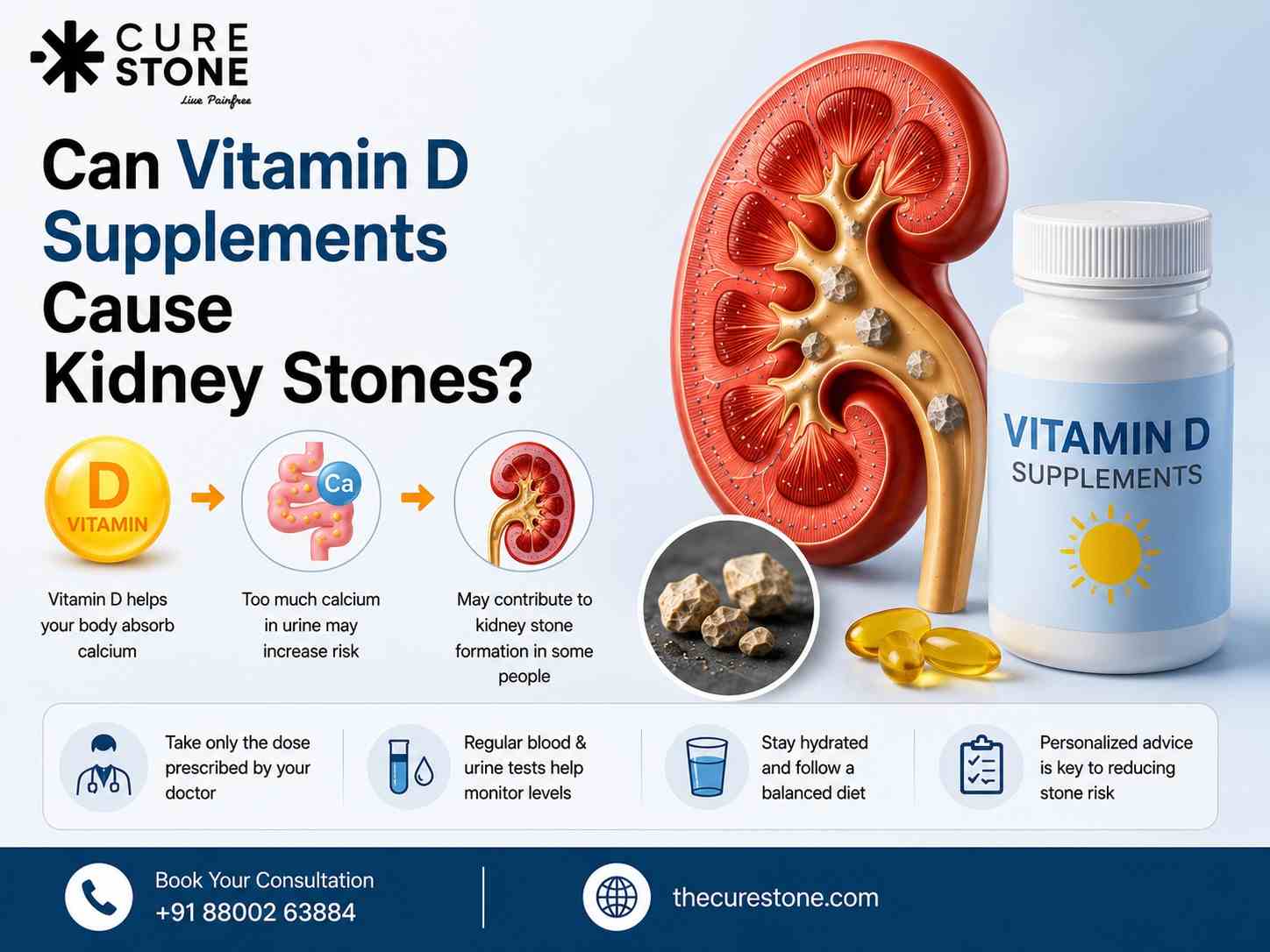
Vitamin D deficiency is diagnosed constantly in India, and the standard response is a 60,000 IU sachet taken weekly. Most people are handed a course, feel better, and simply keep taking it. Many are still taking it two years later without a single repeat blood test.
At the same time, kidney stone rates in urban India keep climbing. It is a fair question whether the two are connected.
The accurate answer sits between the two positions you will find online. Vitamin D taken at correct replacement doses, in someone who is genuinely deficient, with monitoring, is not a proven cause of kidney stones. Vitamin D taken in unmonitored megadoses for months or years, particularly alongside calcium supplements, absolutely can raise your stone risk, and in a small number of people it can do considerably worse than that.
The problem in India is not vitamin D. It is how vitamin D is used.
How Vitamin D Could Cause a Stone
The mechanism is straightforward.
Vitamin D exists to increase calcium absorption from your gut. That is its job. More vitamin D means more calcium crossing from your intestine into your bloodstream.
Your body then has to deal with that calcium. Some goes to bone. The excess is filtered out by the kidneys and ends up in your urine. Higher urinary calcium, called hypercalciuria, is one of the most common abnormalities found in stone formers, because calcium is the raw material for the majority of stones. Our guide on calcium stones, symptoms and treatments explains how they form.
So the chain is: high vitamin D leads to high calcium absorption, which leads to high urinary calcium, which increases the risk of calcium oxalate and calcium phosphate stones.
That is the theory. What the evidence shows is more nuanced.
What the Evidence Actually Says
Studies of vitamin D supplementation alone, at moderate doses in people who were deficient, have generally not shown a clear increase in kidney stone formation. Correcting a genuine deficiency appears to be reasonably safe from a stone perspective.
The picture changes when calcium supplements are added. Large trials of combined calcium and vitamin D supplementation have found a meaningful increase in kidney stone risk. That points the finger at the combination, and particularly at the calcium component, rather than at vitamin D by itself.
The picture changes again at high doses. Vitamin D taken well above replacement requirements, for prolonged periods, without monitoring, produces measurable rises in urinary calcium in a significant proportion of people. That is not disputed.
So the honest summary is this. Replacement dosing in a deficient person, monitored, is low risk. Megadosing indefinitely, unmonitored, especially alongside calcium tablets, is a real risk. Most of the vitamin D use I see in practice falls into the second category.
Where This Goes Wrong in Indian Practice
Five specific problems come up repeatedly.
Nobody rechecks the level. A course of 60,000 IU weekly for eight to twelve weeks is a reasonable correction protocol. Continuing it for two years without measuring anything is not. Deficiency is meant to be corrected and then maintained at a much lower dose, not treated at loading dose forever.
Calcium and vitamin D are prescribed together by default. Combination tablets are everywhere, often given for joint pain, bone health, or after menopause, and frequently continued indefinitely. The combination is where the stone risk concentrates.
Calcium supplements are taken on an empty stomach. This is the single most correctable error. Dietary calcium taken with food binds oxalate in the gut so it never reaches the kidney, which is protective. A calcium tablet swallowed between meals bypasses that entirely and simply raises urinary calcium. See can kidney stone patients consume milk for why food calcium and supplement calcium behave so differently.
It is bought without a prescription. Vitamin D sachets are sold freely, recommended by friends and chemists, and taken by people who never had a level checked in the first place.
Nobody asks about stones. A patient with a history of two kidney stones is put on calcium and vitamin D for bone health, and neither the prescriber nor the patient connects it to the urology history sitting in the same file.
The Group Where This Is Genuinely Dangerous
For most people the worst case is an increased stone risk. For a small group, high dose vitamin D can cause serious harm, and these are the situations where it should not be taken without specialist supervision.
Primary hyperparathyroidism. An overactive parathyroid gland is already pushing calcium into the blood and urine. Adding vitamin D on top can push blood calcium into a dangerous range. This condition is a genuine cause of recurrent stones and is frequently missed for years, which is why anyone with repeated stones should have blood calcium and parathyroid hormone checked.
Sarcoidosis and other granulomatous diseases, including tuberculosis. In these conditions the body converts vitamin D into its active form without normal regulation. Standard doses can produce dangerously high calcium levels. Given how common tuberculosis is in India, this matters.
Existing hypercalciuria. If a 24 hour urine study has already shown high urinary calcium, adding vitamin D without addressing that is working against yourself.
Reduced kidney function or a single kidney. Less margin for error, and calcium deposits in the kidney tissue itself, called nephrocalcinosis, become a real concern.
True vitamin D toxicity. Rare but seen, usually from injections repeated too often or sachets taken daily instead of weekly. It causes high blood calcium, nausea, vomiting, confusion, excessive urination, dehydration, and kidney injury. This is a medical emergency, not a stone problem.
Should You Stop Your Vitamin D?
No, not on your own, and not because of this article.
Vitamin D deficiency is genuinely widespread in India and it is not harmless. It affects bone density, muscle function, and fracture risk. Stopping replacement in someone who needs it trades one problem for another.
What you should do instead is get it used properly.
- Get your level checked before starting and again after completing a correction course. If you have been taking it for over a year with no repeat test, that test is overdue.
- Move from loading dose to maintenance once the level is corrected. Loading protocols are meant to be finite.
- Question the calcium component. If you are on a combination tablet, ask whether you need the calcium at all, particularly if your diet already contains dairy. Most Indians with reasonable dairy intake do not need a calcium supplement.
- If you do take calcium, take it with meals. This single change reduces stone risk without reducing the benefit.
- Tell your urologist and your physician about each other. Bring every supplement, including anything bought over the counter, to both.
- If you have already formed stones, get urinary calcium measured before continuing long term supplementation. A 24 hour urine study answers this directly, as covered in what to expect during your kidney stone tests.
Not every supplement works against stone formers. Our article on vitamin B3 and kidney stone risk looks at one that may work in the opposite direction.
Vitamin D Is Rarely the Whole Story
If you have formed stones while taking vitamin D, it is worth checking, but it is unlikely to be the only factor.
Low urinary citrate, high salt intake, high animal protein intake, low urine volume, high dietary oxalate, and anatomical or infective causes all contribute, often more than the supplement does. Our guides on which factors mainly cause kidney stones, the role of diet in kidney stone formation and prevention, and the 10 foods that cause kidney stones cover the wider picture.
Hydration remains the foundation regardless. See how much water you should drink to prevent kidney stones and why hydration is necessary for kidney health.
For anyone forming stones repeatedly, the real answer is a proper workup rather than eliminating one suspect at a time. That means stone composition analysis, a 24 hour urine study, and blood tests including calcium and parathyroid hormone. Our guides on recurring kidney stones and how to avoid kidney stone recurrence explain what that involves, and kidney stones and the risk of chronic kidney disease explains why it is worth doing properly.
If you already have a stone, our kidney stone checker indicates what your size and location typically require, and our kidney stone treatment page sets out the options including RIRS for scarless removal.
To have your supplements reviewed alongside a full stone assessment, book a consultation with Dr. Deepanshu Gupta.
Frequently Asked Questions
Does vitamin D cause kidney stones?
Vitamin D at correct replacement doses in a genuinely deficient person has not been shown to clearly increase stone risk. High doses taken long term without monitoring, and vitamin D combined with calcium supplements, do increase the risk by raising the amount of calcium in your urine.
Is 60,000 IU of vitamin D weekly safe for kidney stone patients?
As a finite correction course with a repeat blood test afterwards, it is generally acceptable. The problem is when it continues for months or years with no monitoring, which is common. Stone formers should also have urinary calcium checked before long term use.
Can I take vitamin D if I have had kidney stones?
Usually yes, with appropriate dosing and monitoring. Get your vitamin D level and blood calcium checked, have urinary calcium measured if you form stones repeatedly, and be cautious about combination tablets containing calcium.
Is it calcium or vitamin D that causes stones?
The evidence points more strongly at calcium supplements, particularly when taken between meals, than at vitamin D alone. Combined calcium and vitamin D supplementation carries a clearer risk than vitamin D by itself.
Should I stop calcium tablets to prevent kidney stones?
Do not stop dietary calcium, which is protective. Supplemental calcium is different and should be reviewed with your doctor. If you continue it, take it with meals so it binds oxalate in the gut rather than raising urinary calcium.
What are the signs of too much vitamin D?
Nausea, vomiting, poor appetite, excessive thirst, passing large volumes of urine, constipation, confusion, and weakness. These suggest a high blood calcium level and need urgent medical assessment rather than a wait and watch approach.
How do I know if vitamin D is causing my stones?
A 24 hour urine study showing high urinary calcium, combined with a raised blood vitamin D level, points strongly in that direction. Blood calcium and parathyroid hormone should be checked at the same time to rule out an overactive parathyroid gland, which produces a similar picture.
Can vitamin D deficiency itself cause kidney stones?
Deficiency is not a recognised cause of stones. The concern runs in the other direction, with excess rather than deficiency raising urinary calcium.
Have Questions About This Topic?
Get a personalized consultation at Cure Stone Hospital, Sector 52, Gurgaon.
Book Consultation