
Can Diabetes Increase the Risk of Kidney Stones?
Diabetes may increase the risk of developing kidney stones, particularly certain types of stones. Learn how blood sugar, urine chemistry, diet, and metabolic factors can influence stone formation.
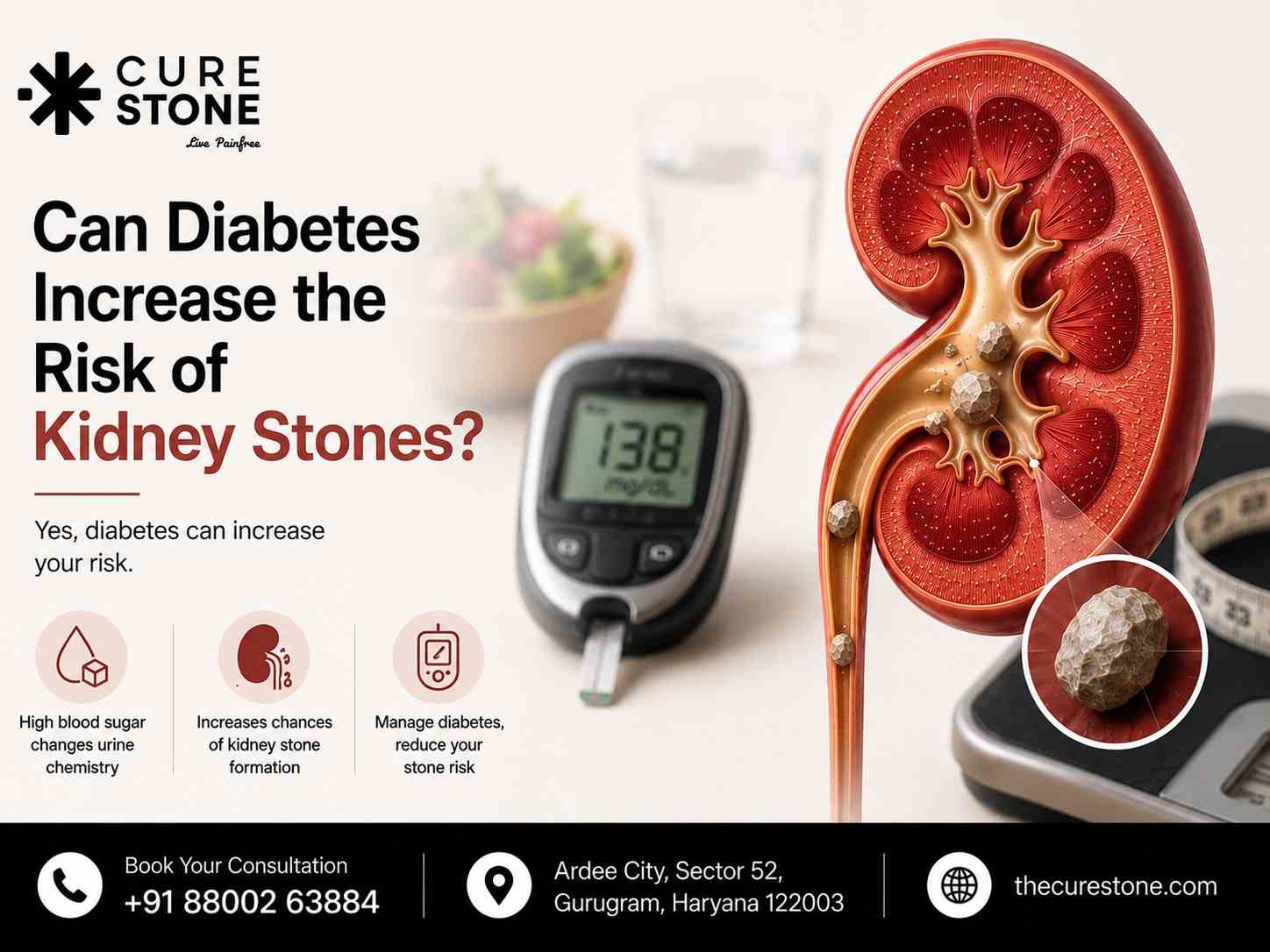
India has one of the largest diabetic populations in the world, and it also sits across one of the world's most active kidney stone belts. Most patients treat these as two separate problems handled by two separate doctors.
They are not separate. Type 2 diabetes measurably increases your risk of forming kidney stones, it changes which type of stone you form, it makes those stones more likely to be discovered late, and it makes the complications more serious when they occur.
If you are diabetic and have had a stone, or if you are diabetic and want to avoid one, this is what is actually happening and what to do about it.
Yes, and the Mechanism Is Specific
Diabetes does not vaguely increase stone risk. It does something precise to your urine.
Insulin resistance impairs the kidney's ability to produce ammonia, which is one of the main ways your body neutralises acid in urine. With less ammonia available, urine becomes persistently more acidic.
Acidic urine is the key. Uric acid is poorly soluble in acidic urine and readily crystallises out of it. So a diabetic patient can be excreting a perfectly normal amount of uric acid and still form uric acid stones, simply because the urine they are excreting it into is the wrong pH.
This is why the pattern of stones changes with diabetes. In the general population, uric acid stones account for a modest share of all stones. In people with type 2 diabetes, that share rises substantially, and the proportion increases further with worsening insulin resistance and with obesity.
Our guide on uric acid stones, complications and treatment explains how they behave, and the 4 different types of kidney stones covers where they sit among the rest.
The Other Contributions
Low urine pH is the main mechanism, but several others stack on top of it.
Obesity and metabolic syndrome. These usually travel with type 2 diabetes and independently increase urinary calcium, oxalate, and uric acid while lowering citrate, your natural stone inhibitor. Many diabetic stone formers have several abnormalities at once rather than one.
Diet. Higher animal protein intake produces an acid load that pushes urine pH down further and raises urinary calcium. Higher salt intake pushes calcium into the urine. Both are common in the same dietary patterns associated with metabolic syndrome. See the role of diet in kidney stone formation and prevention and the right diet for kidney stones.
Fluid balance. Poorly controlled diabetes causes excess urination and fluid loss, and many patients replace less than they lose. Concentrated urine raises the risk of every stone type. See how much water you should drink to prevent kidney stones.
Urinary infections. Diabetics have a higher rate of urinary tract infections, and certain infections drive struvite stones, which are caused by bacteria rather than diet and grow fast. See struvite stones, a different kidney stone and UTI versus kidney infection.
The Problem Nobody Warns Diabetic Patients About
This is the part that matters most and is discussed least.
Long-standing diabetes causes neuropathy, damage to the nerves. Most people know about it in the feet. The same process can affect the nerves supplying the urinary tract and can blunt the perception of visceral pain.
Kidney stones are usually diagnosed because the pain is unbearable. It is one of the few conditions where the symptom reliably forces the patient to seek help. If that alarm is muted, a stone can obstruct a kidney and cause far less pain than it should, or none at all.
The consequence is that some diabetic patients present late, with a stone that has been quietly obstructing for months and a kidney that has already lost function. Diabetics also frequently have reduced sensation of bladder fullness, which contributes to incomplete emptying and stasis.
The practical implication is straightforward. If you are diabetic with a history of stones, do not use pain as your only monitoring system. Periodic imaging matters more for you than for a non-diabetic patient, because the absence of pain is less reassuring. Our article on the role of ultrasound and CT scan in diagnosing kidney stones explains what each scan shows, and what happens if you do not remove kidney stones covers what silent obstruction costs.
Why the Stakes Are Higher
Three reasons a stone matters more in a diabetic patient.
Infection risk. Diabetes impairs immune response, and an infected obstructed kidney can progress to sepsis faster and more severely. Fever with flank pain in a diabetic patient is an emergency, not something to observe overnight. See how to know when a kidney stone is serious.
Compounding kidney damage. Diabetes is already the leading cause of chronic kidney disease in India. Adding repeated obstruction from stones onto a kidney already under strain accelerates the decline. Read kidney stones and the risk of chronic kidney disease, can kidney stones cause permanent kidney damage, and 10 signs of chronic kidney disease.
Surgical considerations. Diabetic patients need tighter perioperative planning, careful glucose control around the procedure, and a lower threshold for treating infection before operating. This is manageable and routine, but it means the procedure should be planned rather than done as an emergency wherever possible.
The One Piece of Good News
Uric acid stones are the only common stone type that can genuinely be dissolved with medication rather than removed.
Because the problem is urine pH rather than the amount of uric acid, raising urine pH with potassium citrate can dissolve existing uric acid stones over weeks to months in appropriately selected patients, and prevent new ones from forming.
That is a meaningful advantage. A diabetic patient who forms uric acid stones may be able to avoid surgery entirely, which is not true for calcium stone formers.
The condition is knowing that is what you have. Nothing you drink dissolves a calcium stone, and treating a calcium stone with alkalinising medication achieves nothing while the stone continues growing. This is why stone composition analysis and a 24 hour urine study matter so much in this group, as covered in what to expect during your kidney stone tests.
What About Diabetes Medications?
Patients often ask whether their diabetes tablets are causing stones. Generally no, and one class may work in the opposite direction.
The newer SGLT2 inhibitors, widely prescribed now for type 2 diabetes and heart and kidney protection, increase urine output substantially. Emerging evidence suggests patients on these medicines may have a lower rate of kidney stones than those on some other diabetes drugs, which fits the mechanism.
Metformin has no established link to stone formation.
As with any medication question, do not change or stop a diabetes medicine because of an article. If you form stones and want your prescription reviewed in that light, raise it with your physician and your urologist together.
What Actually Reduces Your Risk
For a diabetic patient, stone prevention and diabetes management are largely the same project.
- Improve glycaemic control and insulin sensitivity. This addresses the root mechanism rather than the downstream chemistry. Weight reduction and physical activity both improve urine pH over time.
- Increase fluid intake deliberately. Target a urine output of at least 2 to 2.5 litres a day, which usually means drinking three to four litres, and more in hot weather. See why hydration is necessary for kidney health.
- Reduce salt and moderate animal protein. These are higher yield than oxalate restriction for most people in this group, and they help blood pressure and kidney function too.
- Add citrate. Lemon or lime in water provides citrate. For patients with significantly acidic urine, prescribed potassium citrate is considerably more effective.
- Do not cut dietary calcium. It binds oxalate in the gut and is protective. See can kidney stone patients consume milk and what to eat if you have kidney stones.
- Treat urinary infections properly rather than partially. Incompletely treated infections drive struvite stones.
- Get imaging on schedule, not on symptoms. This is the diabetes-specific point. Pain is a less reliable warning system for you.
- Get a full workup after your first stone, not your third. Composition analysis plus a 24 hour urine study. Our guides on recurring kidney stones and how to avoid kidney stone recurrence explain why.
If you already have a stone, our kidney stone checker gives an indication of what your size and location typically require, and our kidney stone treatment page sets out the options, including RIRS, which removes stones through the natural urinary passage with no cut and no scar and suits diabetic patients well because wound healing is not a factor.
For an assessment that treats your diabetes and your stones as one problem rather than two, book a consultation with Dr. Deepanshu Gupta.
Frequently Asked Questions
Does diabetes cause kidney stones?
Diabetes does not directly create stones, but insulin resistance makes urine persistently more acidic, which strongly favours uric acid stone formation. People with type 2 diabetes have a higher overall stone risk and a much higher proportion of uric acid stones than the general population.
What type of kidney stone do diabetics usually get?
Uric acid stones are disproportionately common in diabetes, though calcium stones still occur. The shift toward uric acid stones tracks with the degree of insulin resistance and obesity.
Can controlling my blood sugar prevent kidney stones?
It addresses the underlying mechanism, so it helps, though it works gradually rather than immediately. Improving insulin sensitivity, reducing weight, and increasing physical activity all tend to raise urine pH over time.
Why might a diabetic not feel kidney stone pain?
Long-standing diabetes can cause nerve damage that blunts the perception of visceral pain. A stone can therefore obstruct a kidney with far less pain than expected, which is why diabetic patients sometimes present late with established kidney damage.
Are kidney stones more dangerous if you have diabetes?
The stone itself is the same, but the consequences can be worse. Infection risk is higher, sepsis can progress faster, pain may be a less reliable warning, and the kidney is often already under strain from diabetes itself.
Can uric acid stones be dissolved without surgery?
Yes, in appropriately selected patients. Because these stones form due to acidic urine, medication that raises urine pH can dissolve them over weeks to months. This only applies to uric acid stones, which is why identifying the stone type is essential.
Do diabetes medicines cause kidney stones?
There is no established link with metformin, and emerging evidence suggests SGLT2 inhibitors may actually be associated with a lower stone rate. Never stop or change a diabetes medicine on your own, but do discuss your full medication list with your urologist.
How often should a diabetic with previous stones get scanned?
This should be individualised, but the interval is generally shorter than for a non-diabetic patient because pain is a less reliable indicator. Discuss a specific imaging schedule with your urologist rather than waiting for symptoms.
Have Questions About This Topic?
Get a personalized consultation at Cure Stone Hospital, Sector 52, Gurgaon.
Book Consultation