
How Serious Is a 15mm Kidney Stone?
A 15mm kidney stone is considered a large stone and is unlikely to pass naturally. Learn about potential complications, treatment options, and when medical evaluation is important.
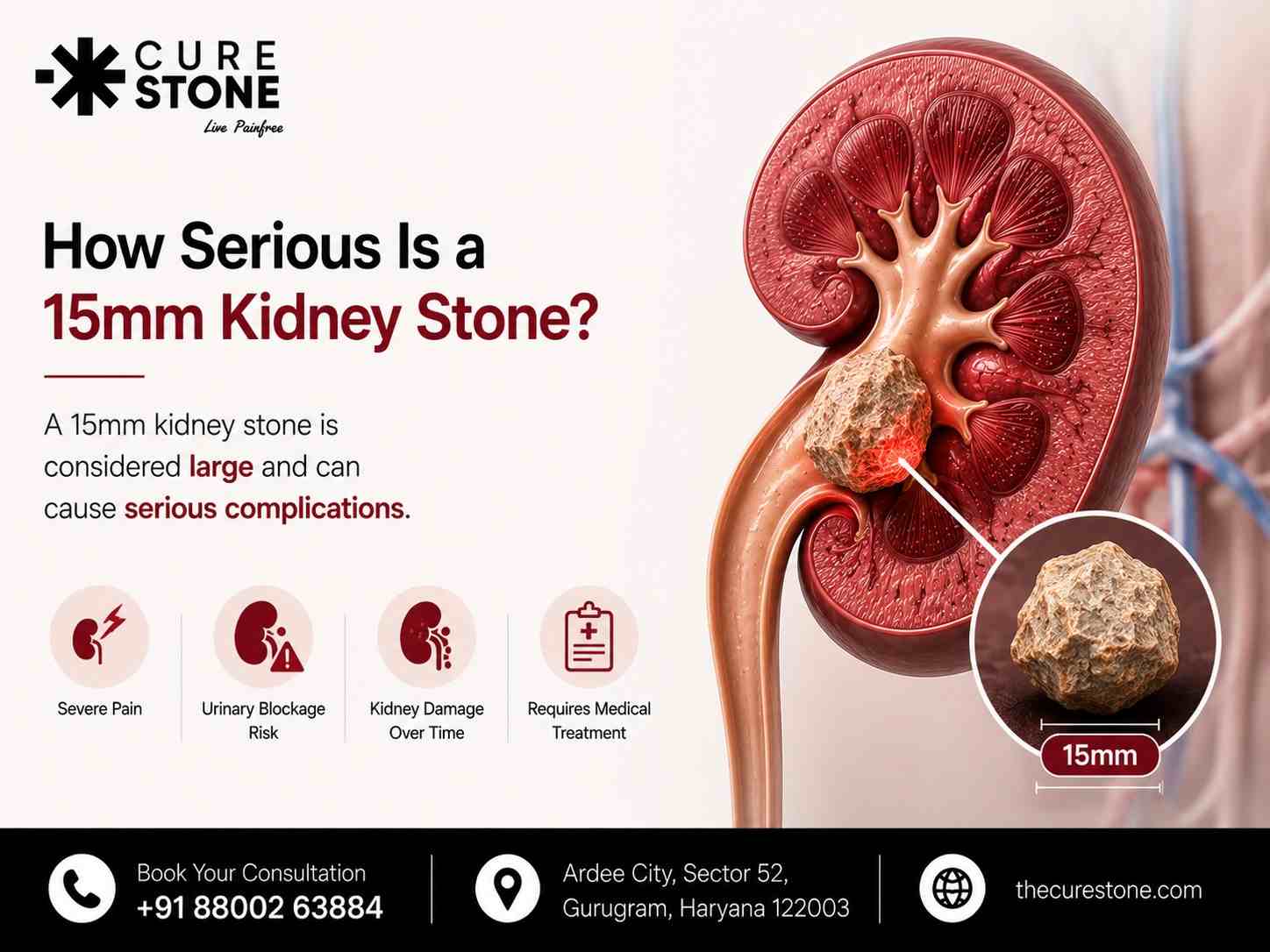
A 15mm stone changes the conversation. Below 6mm, patients ask whether it will pass. At 15mm, that question is settled. It will not pass, and it will not dissolve.
So the real question becomes different: how much harm is it doing right now, how urgently does it need dealing with, and what happens if you postpone.
The honest answer is that a 15mm stone is serious but rarely an emergency, and the difference between those two words is where most patients get their planning wrong. Some 15mm stones need treating this week. Others can be scheduled in a month around your work. A few situations mean going to hospital today.
Here is how to tell which you have.
First, Understand the Size
15mm is roughly the width of a fingernail sitting inside your kidney. That already sounds significant, but the diameter understates it.
Stone volume scales with the cube of the diameter, so a 15mm stone contains around three and a half times the material of a 10mm stone, and more than twenty times that of a 6mm one. That matters because treatment planning depends on total stone burden, not on the number in your report. See the best treatment for 10mm kidney stones and the best treatment for 12mm kidney stones for how the decision shifts across that range.
It also means a 15mm stone is well past every threshold for spontaneous passage. Nothing you drink, eat, or take will move it, with the single exception of a pure uric acid stone, which can sometimes be dissolved with medication that raises urine pH. That applies to a minority of stones and only once composition is known.
The Question That Decides Severity: Is It Blocking?
This is the variable that matters most, and it is why two patients with identical 15mm reports can receive completely different advice.
A 15mm stone sitting inside the kidney, not obstructing. Often causing minimal or no pain. Urine is draining normally, kidney function on that side is preserved, and there is no immediate danger. This is a stone that needs planned treatment, not urgent treatment. You have time to arrange leave, complete pre-operative tests, and choose your surgeon properly.
A 15mm stone obstructing the outflow. Urine cannot drain, pressure builds, and the kidney swells. This is hydronephrosis, and it is a clock running. Function is being lost while you decide. See hydronephrosis, causes and treatment.
A 15mm stone obstructing with infection behind it. This is a surgical emergency and the situation can deteriorate within hours.
A 15mm stone rarely lodges in the ureter, because it is too large to enter it in the first place. Obstruction at this size usually happens at the junction where the kidney drains into the ureter, or because the stone sits in a position that blocks a calyx.
Your scan report will usually mention hydronephrosis if present. If it does, ask your urologist how severe and how long it may have been there.
When It Becomes an Emergency
Go to hospital immediately, not to a clinic appointment next week, if you have:
- Fever or chills alongside flank pain. An infected obstructed kidney can progress to sepsis rapidly. This is the single most dangerous scenario in stone disease.
- Passing very little or no urine. Particularly concerning if you have one functioning kidney or stones on both sides.
- Pain not controlled by your prescribed medication.
- Persistent vomiting preventing fluids and tablets.
- Confusion, rapid heartbeat, or feeling profoundly unwell. These suggest systemic infection.
Our guides on how to know when a kidney stone is serious and are kidney stones dangerous cover the warning signs in more detail.
When It Is Serious but Not Urgent
Most 15mm stones fall here. Treatment is necessary, and it should be scheduled within weeks rather than months, but there is no need to panic or to accept the first available surgery slot without thinking.
Use that window properly. Get the stone characterised on CT including its density, get your kidney function checked, get any urinary infection treated before surgery rather than during it, and understand which procedure is being proposed and why. See RIRS versus PCNL versus ESWL.
The Situations That Raise the Stakes
Certain factors make a 15mm stone considerably more serious than the size alone suggests:
- A single functioning kidney or a transplanted kidney. No reserve, so any obstruction matters immediately.
- Stones on both sides. Bilateral obstruction is a different clinical situation entirely.
- Existing kidney disease or reduced function. See 10 signs of chronic kidney disease.
- Diabetes. Higher infection risk, and nerve damage can blunt the pain that would normally warn you something is wrong.
- A history of urinary infections. Raises the chance this is a struvite stone, which grows fast and regrows from any fragment left behind. See struvite stones, a different kidney stone.
- Pregnancy, where both assessment and treatment need specialist handling.
- Previous incomplete stone surgery, since residual fragments behave differently from a fresh stone.
What Happens If You Postpone
This is the part patients most often underestimate, because a stone causing little pain does not feel like a problem.
It will grow. Stones do not stay static. Calcium stones grow slowly over years, but struvite infection stones can grow rapidly and a 15mm stone can progress toward staghorn within a year. A larger stone is harder to treat, more likely to need a percutaneous approach through the back rather than a scarless retrograde one, and more likely to need more than one sitting. See staghorn kidney stones and how to remove them.
Silent obstruction costs kidney function permanently. This is the real danger of a painless large stone. The kidney thins and loses function gradually, and by the time anything is noticed a significant proportion may be gone and it does not come back. See can kidney stones cause permanent kidney damage and what happens if you do not remove kidney stones.
Infection risk compounds. A large stone acts as a reservoir for bacteria that antibiotics cannot fully reach, producing repeated infections that never quite clear.
Long term consequences accumulate. Repeated or prolonged obstruction contributes to chronic kidney disease, as covered in kidney stones and the risk of chronic kidney disease. Very long standing stones with chronic inflammation also carry a small increased risk of malignant change, discussed in can kidney stones cause kidney cancer.
If you are weighing a delay, can I delay kidney stone removal sets out how to think about it.
How a 15mm Stone Is Usually Treated
The reassuring part is that treatment at this size is routine and does not require open surgery.
RIRS is the most common approach. A flexible scope passes through the natural urinary passage into the kidney, a laser fragments the stone, and there is no cut and no scar. Most patients go home the same day or the next morning.
At 15mm the fragment burden is significant, which is where suction assisted techniques matter. Sheaths that apply continuous suction remove fragments during the operation rather than leaving them to be passed or basketed out one at a time, which improves the chance of finishing genuinely stone free. See FANS RIRS and suction RIRS.
A percutaneous approach through the flank may be preferred if the stone is very dense, sits in an unfavourable lower pole anatomy, or is part of a larger overall burden. See the best treatment for 15 to 20mm kidney stones, small versus large kidney stones and which surgery works best, and what is the best way to remove large kidney stones.
Shock wave treatment is generally a poor choice at this size, because the fragment burden it creates has to pass on its own.
A temporary stent is often placed and removed a week or two later in a short outpatient procedure.
The Step Most Patients Skip
Removing a 15mm stone solves today's problem. It does not address why your body built a stone that size.
Roughly half of stone formers develop another stone within five to ten years when the underlying cause is never identified. For a stone this large, the cause is worth finding, because the next one starting now will take years to reach this size and can be prevented in that window.
That means keeping the fragments for composition analysis, and a metabolic evaluation measuring what your urine is doing across a full day. See what to expect during your kidney stone tests, recurring kidney stones, and how to avoid kidney stone recurrence.
Post-operative imaging matters too. Being told the surgery went well is not the same as being confirmed stone free, and leftover fragments are a common reason a stone appears to come back within two years. See why aftercare and follow up are important after kidney stone surgery.
Our kidney stone checker gives a quick indication of what your size and location typically require, and our kidney stone treatment page sets out the options. For a straight assessment of how urgent your stone is, book a consultation with Dr. Deepanshu Gupta.
Frequently Asked Questions
Is a 15mm kidney stone dangerous?
It is serious and needs treatment, but whether it is dangerous right now depends on whether it is blocking urine flow and whether infection is present. A non-obstructing 15mm stone can be treated on a planned basis. An obstructed and infected one is an emergency.
Can a 15mm kidney stone pass on its own?
No. It is far too large to travel down the ureter. Waiting will not help and allows the stone to grow and potentially damage the kidney.
Can a 15mm kidney stone be dissolved with medicine?
Only if it is a pure uric acid stone, which can sometimes be dissolved with medication that raises urine pH over weeks to months. Calcium stones, which are the most common, cannot be dissolved by any medicine or home remedy.
How urgent is surgery for a 15mm stone?
Urgent within hours if there is fever, no urine output, uncontrolled pain, or a single kidney affected. Otherwise it should generally be scheduled within weeks rather than deferred for months.
Will a 15mm stone need open surgery?
No. It is routinely treated through the natural urinary passage with a scope and laser, leaving no scar, or through a small percutaneous tract if the anatomy or stone density favours that. Open surgery is essentially obsolete for stones of this size.
How long is recovery after treatment for a 15mm stone?
Most patients treated retrogradely go home the same day or the next morning and return to desk work within a few days. A stent, if placed, is usually removed within one to three weeks.
Can a 15mm stone damage my kidney even if it does not hurt?
Yes, and this is the main risk of a silent stone. Pain comes from obstruction rather than from the stone itself, so a large stone can quietly reduce kidney function over months without producing severe symptoms.
Will it come back after removal?
It can, for two reasons: fragments left behind that regrow, or the underlying cause never being corrected. Post-operative imaging addresses the first, and stone analysis plus a metabolic workup addresses the second.
Have Questions About This Topic?
Get a personalized consultation at Cure Stone Hospital, Sector 52, Gurgaon.
Book Consultation