
Kidney Stone Analysis: What Does a Stone Test Tell You?
Kidney stone analysis can reveal what a stone is made of and help doctors understand why it formed. Learn how stone testing works and how results guide prevention.
Most patients treat the stone as rubbish once it is out. It gets flushed, thrown away, or left in a paper cup at the hospital and forgotten. That is a mistake, because the stone itself is the single most informative piece of evidence you will ever have about why your body is making stones.
A stone analysis, formally called stone composition analysis, tells your urologist what the stone is made of. That one piece of information changes your diet advice, your medication, your follow up schedule, and your realistic risk of getting another one. Without it, prevention is guesswork.
If you have ever been told to simply drink more water and avoid tomatoes, you were almost certainly being given generic advice because nobody knew what your stone was made of.
What Is Kidney Stone Analysis?
Stone analysis is a laboratory test performed on a stone you have passed naturally or that was removed during surgery. The lab breaks down the chemical makeup of the stone and reports the percentage of each component, for example 80 percent calcium oxalate monohydrate and 20 percent calcium phosphate.
The most reliable method is infrared spectroscopy or X ray diffraction. Older wet chemical methods are cheaper but far less accurate, particularly with mixed stones, so it is worth asking your lab which technique they use.
The test itself is quick and inexpensive. The delay is almost always in the patient remembering to collect the stone in the first place.
Why the Composition Matters More Than the Size
Size decides your treatment. Composition decides your future.
A 12mm stone and a 5mm stone may both be removed successfully, and our guides on the best treatment for 12mm kidney stones and the best treatment for 5mm kidney stones explain how size drives that decision. But once the stone is out, size tells you nothing about whether it will happen again.
Composition does. It points directly at the metabolic problem producing the stones, and each type has a different fix. Treating a uric acid stone with calcium oxalate advice is not just useless, it wastes the one window you have to prevent recurrence.
This matters because recurrence is common. A significant proportion of stone formers develop another stone within five to ten years if nothing is corrected. Our article on recurring kidney stones covers that pattern in detail.
The Main Stone Types and What Each One Tells You
There are four main categories, covered in full in our guide to the 4 different types of kidney stones.
Calcium Oxalate
The most common type by a wide margin. A calcium oxalate result points toward high dietary oxalate, low fluid intake, low dietary calcium, or high urinary oxalate excretion.
The counterintuitive part is that cutting calcium out of your diet makes these stones more likely, not less. Dietary calcium binds oxalate in the gut so it never reaches the kidney. This is why our article on whether kidney stone patients can consume milk matters more than most patients expect. More on this type in calcium stones, symptoms and treatments.
Uric Acid
These form in persistently acidic urine and are strongly linked to high protein intake, gout, obesity, diabetes, and metabolic syndrome. They are also the one stone type that can genuinely be dissolved medically, by alkalinising the urine with potassium citrate.
That is the clearest example of why the test is worth doing. A uric acid stone may be treatable without any surgery at all, but only if you know it is uric acid. See uric acid stones, complications and treatment.
Uric acid stones are also often invisible on plain X ray, which is one reason imaging alone cannot replace a composition test. Our guide on the role of ultrasound and CT scan in diagnosing kidney stones explains what each scan can and cannot see.
Struvite (Infection Stones)
These are not a diet problem. They form because of specific urea splitting bacteria in the urinary tract, and they grow fast, often filling the whole collecting system as a staghorn stone.
A struvite result changes everything about your follow up. It means the infection source must be found and cleared, and it means every fragment must be removed, because a single leftover piece keeps the bacteria alive and the stone regrows. Read more in struvite stones, a different kidney stone. If you have a history of urinary infections, our guide on UTI versus kidney infection is worth reading alongside it.
Cystine
Rare, and caused by an inherited disorder of amino acid transport rather than anything you ate. A cystine result means lifelong management, very high fluid targets, specific medication, and screening of family members. It also usually means the stones started young. Our article on hereditary causes of kidney stones explains the genetic side.
What Your Report Actually Looks Like
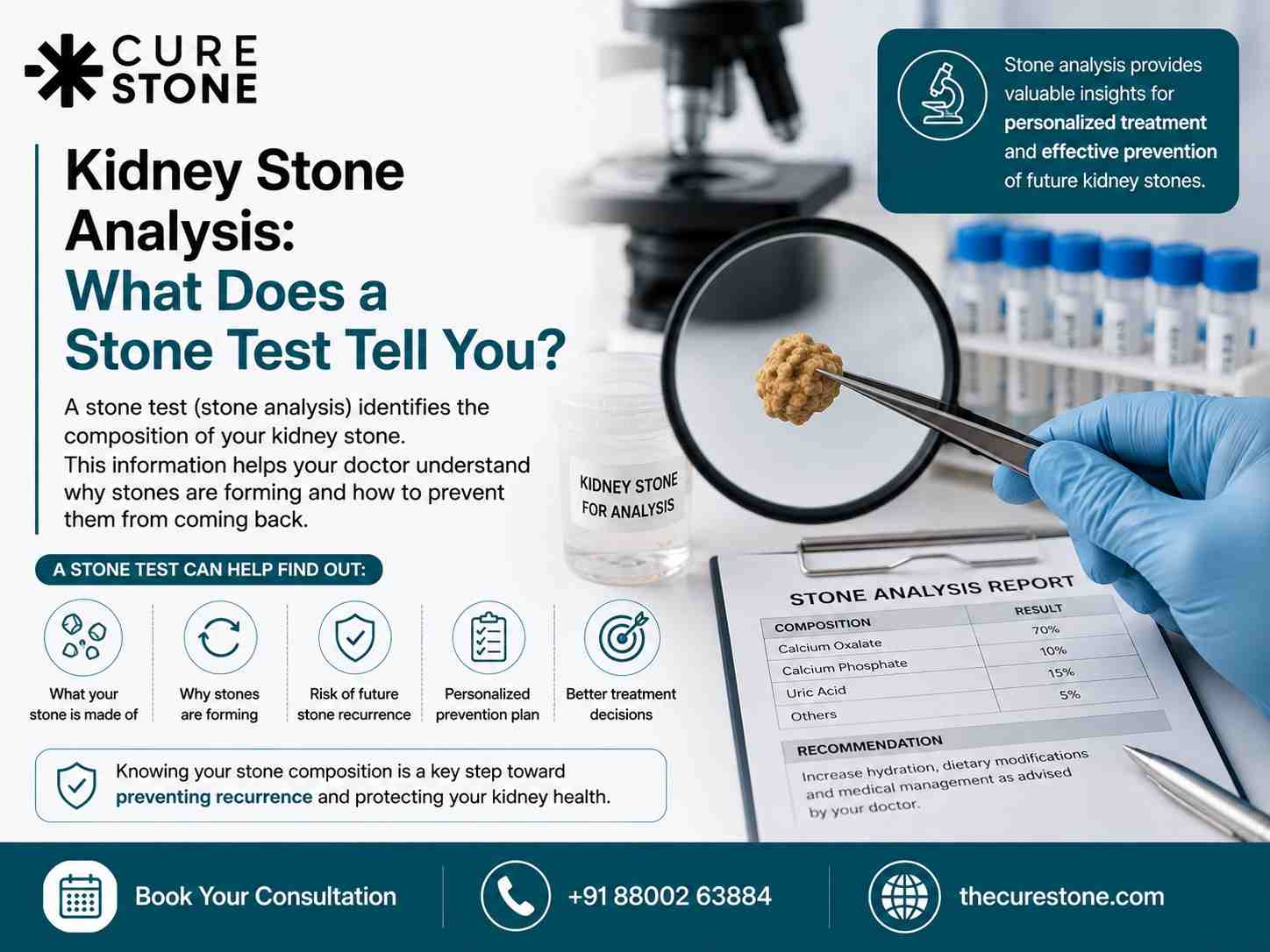
A typical report gives you percentages rather than a single label, because most stones are mixed. You may see something like calcium oxalate monohydrate 70 percent, calcium oxalate dihydrate 20 percent, calcium phosphate 10 percent.
The dominant component drives the prevention plan, but the minor components carry information too. A meaningful calcium phosphate fraction, for example, can point toward renal tubular acidosis or a parathyroid problem, both of which need blood tests rather than dietary changes. Monohydrate stones are also harder and denser than dihydrate stones, which is one reason some stones respond poorly to shock wave therapy and do better with RIRS.
That last point is practical. If shock wave lithotripsy failed on your previous stone, the composition often explains why, and it tells your surgeon not to repeat the same approach. Our comparison of laser versus shockwave treatment covers this.
The Tests That Go With It
Stone analysis is one half of the picture. The other half is a metabolic workup, which usually includes a 24 hour urine collection measuring volume, calcium, oxalate, citrate, uric acid, sodium, and pH, plus blood tests for calcium, uric acid, creatinine, and parathyroid hormone where indicated.
The stone tells you what was built. The urine tells you the conditions that built it. Together they produce a prevention plan specific to you rather than a generic handout. For what to expect from the wider diagnostic process, see what to expect during your kidney stone tests.
Understanding which factors mainly cause kidney stones helps you interpret those results in context.
How to Collect Your Stone Properly
This is where most patients lose the opportunity.
Strain every single urine sample through a fine mesh strainer, a tea strainer, or clean gauze from the moment you are told a stone may pass. Stones can be as small as a grain of sand and are easily missed.
When you catch one, rinse it gently in water, let it air dry, and store it in a small dry container. Do not store it in water, saline, tape, or tissue paper, and do not add any preservative. Take it to your urologist even if it looks like nothing more than a speck of grit.
If your stone was removed surgically, ask specifically for the fragments to be sent for analysis. It is not always done automatically, and once the specimen is discarded the chance is gone. Our guide on what to do after you pass a stone walks through the steps.
What Changes After the Result
This is the part that makes the test worth doing.
Your diet advice becomes specific instead of generic. Oxalate restriction only makes sense for oxalate stones. Purine restriction only makes sense for uric acid stones. Neither helps a struvite former. Our guides on what to eat if you have kidney stones and the 10 foods that cause kidney stones are far more useful once you know your type.
Medication becomes targeted. Potassium citrate, thiazides, and allopurinol each address different mechanisms, and prescribing the wrong one achieves nothing.
Follow up intervals change. A cystine or struvite former needs closer surveillance than a first time calcium oxalate former with a correctable habit.
And your treatment planning for any future stone improves, since your surgeon already knows how your stones behave. Read how to avoid kidney stone recurrence and the role of diet in kidney stone formation and prevention for the practical plan.
Who Should Definitely Get a Stone Analysis
Everyone who passes or has a stone removed benefits, but it is essential if you fall into any of these groups:
- You have had more than one stone episode
- Your first stone appeared before the age of 25
- You have a family history of stones
- You have only one functioning kidney, a transplant, or existing kidney disease
- You have recurrent urinary tract infections
- You have gout, inflammatory bowel disease, or have had bariatric surgery
- Your stone was a large or staghorn stone
- A previous treatment failed to clear the stone completely
If you are unsure what your stone size and location mean for treatment, our kidney stone checker gives you a quick starting point, and our kidney stone treatment page explains the options available.
To have your stone analysed and a proper prevention plan built around the result, book a consultation with Dr. Deepanshu Gupta.
Frequently Asked Questions
What is a kidney stone analysis test?
It is a laboratory test that identifies the chemical composition of a passed or surgically removed stone, usually by infrared spectroscopy or X ray diffraction. The report lists each component as a percentage of the total stone.
How much does kidney stone analysis cost in India?
It is one of the cheaper investigations in stone care, typically costing far less than a CT scan, and it is available at most mid sized and large laboratories. Given that it directs your entire prevention plan, the cost to benefit ratio is among the best in urology.
Can a kidney stone be analysed without passing it?
Not directly. Composition can be estimated from CT Hounsfield units and from urine chemistry, and an experienced urologist can often make a good prediction, but only laboratory analysis of the actual stone gives a definitive answer.
How long does the result take?
Most laboratories report within three to seven days, depending on the method used and whether the sample needs to be sent to a reference lab.
Does the stone need to be preserved in liquid?
No. Store it dry in a clean container. Water, saline, and preservatives can alter or dissolve parts of the stone and compromise the result. Tape and tissue can also contaminate the sample.
What if I lost my stone?
You have not lost the chance to prevent recurrence, only the most direct evidence. A 24 hour urine study, blood tests, and a review of your imaging can still build a solid prevention plan. Strain your urine carefully if another episode occurs.
Will the analysis tell me if I will get another stone?
It does not predict recurrence with certainty, but it identifies the mechanism driving stone formation, and correcting that mechanism is what meaningfully lowers your risk. Type also influences risk, with struvite and cystine stones being more likely to recur than a single episode calcium oxalate stone.
Do all stone types get treated the same way?
No. Treatment choice depends on size, location, hardness, and type. Our guide on types of kidney stones and how they are treated differently explains where the approaches diverge.
Have Questions About This Topic?
Get a personalized consultation at Cure Stone Hospital, Sector 52, Gurgaon.
Book Consultation