
24-Hour Urine Test for Kidney Stones: What Does It Check?
A 24-hour urine test can help identify factors that increase your risk of kidney stones. Learn what the test checks, how it is done, and what the results may reveal.
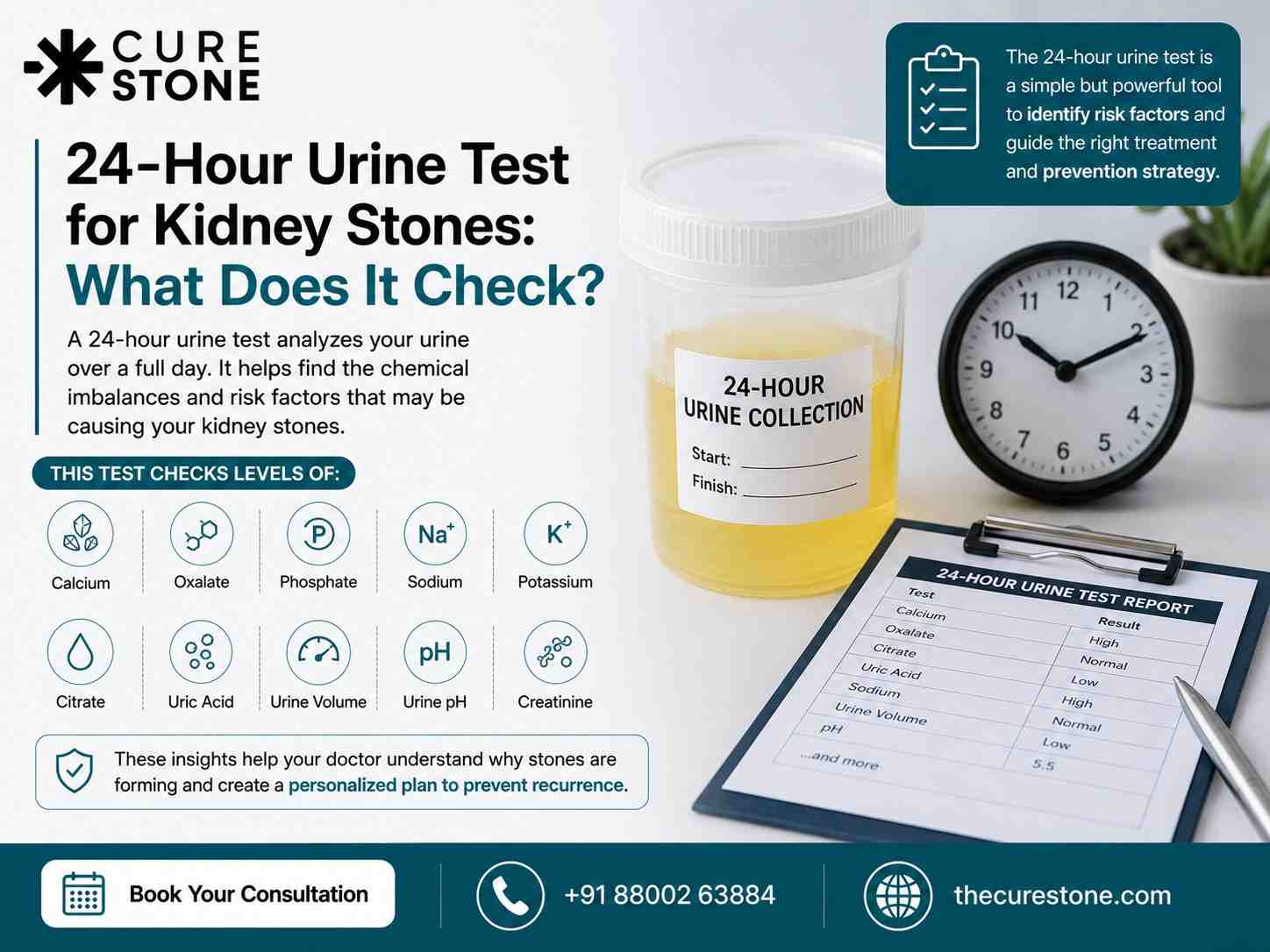
If you have had more than one kidney stone, at some point a urologist should have asked you to collect your urine for a full day. Most patients find the request inconvenient, slightly embarrassing, and hard to take seriously. Many quietly skip it.
That is unfortunate, because the 24 hour urine test is the closest thing stone medicine has to a blueprint. A scan shows you the stone that already formed. A stone analysis tells you what it was made of. The 24 hour urine tells you why your body keeps making them, and it is the only test that measures the actual chemical environment inside your kidneys over a full day and night.
Here is what it measures, what the numbers mean, and how to do the collection properly so the result is worth having.
Why a Single Urine Sample Is Not Enough
A routine urine test taken in the clinic captures one moment. Your urine chemistry swings enormously across a day depending on what you ate, how much you drank, how much you sweated, and whether you slept in an air conditioned room.
Stones do not form in a moment. They form during the hours when urine is most concentrated and most chemically favourable to crystal growth, which for most people is overnight. A spot sample can easily miss that window entirely and come back looking normal while the real problem sits untouched.
Collecting everything over 24 hours averages out the noise and gives a genuine picture of daily excretion. That is why it is the standard metabolic workup worldwide rather than a shortcut test.
What the 24 Hour Urine Test Actually Measures
A full stone risk panel typically reports the following.
Urine Volume
The most important number on the whole report, and the one patients most often fail.
Low volume concentrates every stone forming salt at once. Most guidelines target a urine output of at least 2 to 2.5 litres per day, which in the Indian climate usually means drinking noticeably more than that, especially for anyone working outdoors or in a hot kitchen. Our guides on how much water you should drink to prevent kidney stones and why hydration is necessary for kidney health explain the practical targets.
If your volume comes back at 900ml, no amount of dietary fine tuning will fix your stone risk until that number moves.
Calcium
High urinary calcium, known as hypercalciuria, is one of the most common abnormalities found in stone formers. It can be caused by high salt intake, high animal protein intake, certain medications, or a genuine metabolic condition such as hyperparathyroidism.
The important distinction is that high urine calcium usually does not mean you should eat less calcium. Cutting dietary calcium tends to increase oxalate absorption and worsen stone risk. Our article on whether kidney stone patients can consume milk covers this properly, and calcium stones, symptoms and treatments explains the mechanism.
Oxalate
Oxalate binds calcium in the urine to form the most common type of stone. High urinary oxalate can come from diet, from very low calcium intake, or from gut conditions that increase absorption, including inflammatory bowel disease and previous bariatric surgery.
Diet is the usual driver in India, and the list of high oxalate foods is longer than most patients assume. Our guides on the 10 foods that cause kidney stones and the role of diet in kidney stone formation and prevention go through them. If you have ongoing gut symptoms, kidney stones and digestive issues is worth reading alongside your result.
Citrate
Citrate is your body's natural stone inhibitor. It binds calcium in the urine so it cannot bind oxalate, and it also directly interferes with crystal growth.
Low citrate, called hypocitraturia, is extremely common and very treatable. It is often caused by chronic diarrhoea, high animal protein intake, or acidic urine. Potassium citrate supplementation corrects it directly, which is why this single number often changes the prescription.
Uric Acid
High urinary uric acid raises the risk of uric acid stones and also promotes calcium oxalate crystal formation. It is linked to high purine intake, gout, obesity, and metabolic syndrome. More detail in uric acid stones, complications and treatment.
Urine pH
pH is the quiet decider of stone type.
Persistently acidic urine, generally below 5.5, favours uric acid stones. Persistently alkaline urine, generally above 7, favours calcium phosphate and struvite stones. Struvite specifically points toward infection rather than diet, which changes your entire management plan. See struvite stones, a different kidney stone and UTI versus kidney infection.
Sodium
Sodium is included because it drives calcium excretion. Every extra gram of salt pushes more calcium into your urine. For most Indian patients this is the highest yield dietary change available, ahead of oxalate restriction, because the baseline salt intake in pickles, papad, namkeen, and restaurant food is already far above target.
Creatinine
This one is not about stone risk. It confirms whether your collection was complete. If the creatinine is far below what your body size predicts, you missed samples and the entire report is unreliable. Labs use it as a quality check, and it is the main reason poorly collected tests get rejected.
Supersaturation Values
Better laboratories also calculate supersaturation ratios for calcium oxalate, calcium phosphate, and uric acid. These combine all the individual values into a single measure of how close your urine is to actually forming each type of crystal. They are the most directly actionable numbers on the report, because they can be tracked before and after treatment to prove whether the plan is working.
How to Do the Collection Correctly
The test is only as good as the collection. Follow this exactly.
- Collect on a normal day. Do not go on a special diet, drink extra water, or avoid your usual foods. The point is to capture your real life, not your best behaviour. A cleaned up week produces a normal looking report and a wasted test.
- Start by emptying your bladder and discarding that first sample. Note the time. This is hour zero.
- Collect every single urine sample from that point on, including any passed at night.
- Finish by passing urine at the same time the next day and including that final sample.
- Keep the container refrigerated or in a cool place during the collection unless the lab has supplied a preservative and told you otherwise.
- If you miss a sample, tell the lab. It is better to restart than to submit an incomplete collection that will be misread.
- Avoid collecting during an active urinary infection or immediately after a stone episode or surgery, since the results will be distorted. Most urologists wait four to six weeks after treatment.
Two collections on separate days give a more reliable picture than one, and many urologists prefer that for recurrent stone formers.
What Happens After the Result
The report converts vague advice into a specific plan.
Low volume leads to a fluid prescription with a measured target rather than a vague instruction to drink more. High sodium leads to a salt reduction plan. High oxalate leads to targeted food changes plus adequate dietary calcium timed with meals. Low citrate leads to potassium citrate. High calcium with a normal blood picture may lead to a thiazide diuretic. High uric acid may lead to allopurinol or dietary purine reduction.
Crucially, the test is repeated after three to six months to check whether the numbers actually moved. That feedback loop is what separates real prevention from a printed diet sheet. Our guides on how to avoid kidney stone recurrence and the right diet for kidney stones explain what that plan looks like in practice.
The 24 hour urine works best alongside a composition analysis of the stone itself, since one tells you what was built and the other tells you the conditions that built it. Together they cover the whole picture, and our overview of the 4 different types of kidney stones explains how the two connect.
Who Should Get This Test
It is not necessary for every single first time stone former with an obvious correctable cause. It is strongly indicated if:
- You have had two or more stone episodes
- Your first stone appeared young
- You have a family history of stones, covered in hereditary causes of kidney stones
- You have a staghorn stone or bilateral stones
- You have only one functioning kidney, a transplant, or existing kidney disease
- You have gout, inflammatory bowel disease, or have had bariatric surgery
- You have recurrent urinary infections
- You form stones despite already following prevention advice
Recurrence is the reason this matters. A substantial share of stone formers make another stone within five to ten years without correction, and repeated obstruction carries a real long term cost, as covered in kidney stones and the risk of chronic kidney disease.
For a broader view of the diagnostic process, see what to expect during your kidney stone tests, the role of ultrasound and CT scan in diagnosing kidney stones, and which factors mainly cause kidney stones.
If you keep forming stones and nobody has yet explained why, book a consultation with Dr. Deepanshu Gupta for a full metabolic assessment. Our kidney stone treatment page sets out the treatment options if a stone still needs removing.
Frequently Asked Questions
What does a 24 hour urine test check for kidney stones?
It measures total urine volume, calcium, oxalate, citrate, uric acid, sodium, pH, and creatinine, and many labs also calculate supersaturation values for the main stone types. Together these show why your urine is forming crystals.
Do I need to follow a special diet before the test?
No, and doing so ruins the test. Eat and drink exactly as you normally would, since the purpose is to measure your everyday risk rather than your risk on a carefully behaved day.
What happens if I miss one urine sample?
Tell the laboratory. A missed sample lowers the measured creatinine and makes every other value look falsely low, which can lead to a real abnormality being overlooked. It is better to repeat the collection.
Can I do this test during a stone attack?
It should be delayed. Pain, dehydration, painkillers, and obstruction all distort the numbers. Most urologists wait around four to six weeks after the stone has passed or been removed.
Does the urine need to be refrigerated?
Usually yes, unless the lab provides a preservative and instructs otherwise. Warm urine can lose citrate and allow crystals to form in the container, which changes the reported values.
How often should the test be repeated?
Typically once at baseline, then again three to six months after starting treatment to confirm the numbers improved, then annually for recurrent stone formers.
Is the 24 hour urine test the same as a stone analysis?
No. Stone analysis examines the stone itself and identifies its chemical makeup. The 24 hour urine examines the environment that produced it. Ideally you have both, since each answers a different question.
Can a normal result mean I will never get another stone?
No. A normal panel is reassuring and usually points toward fluid intake and simple dietary factors as the main lever, but it does not guarantee anything. It also means it is worth repeating the collection, since a single day can occasionally miss an intermittent abnormality.
Have Questions About This Topic?
Get a personalized consultation at Cure Stone Hospital, Sector 52, Gurgaon.
Book Consultation