Why Do Some People Keep Getting Kidney Stones Despite Drinking Enough Water?
Drinking enough water does not always prevent kidney stones. Learn why some people develop recurring stones and the dietary, metabolic, genetic, and medical factors involved.
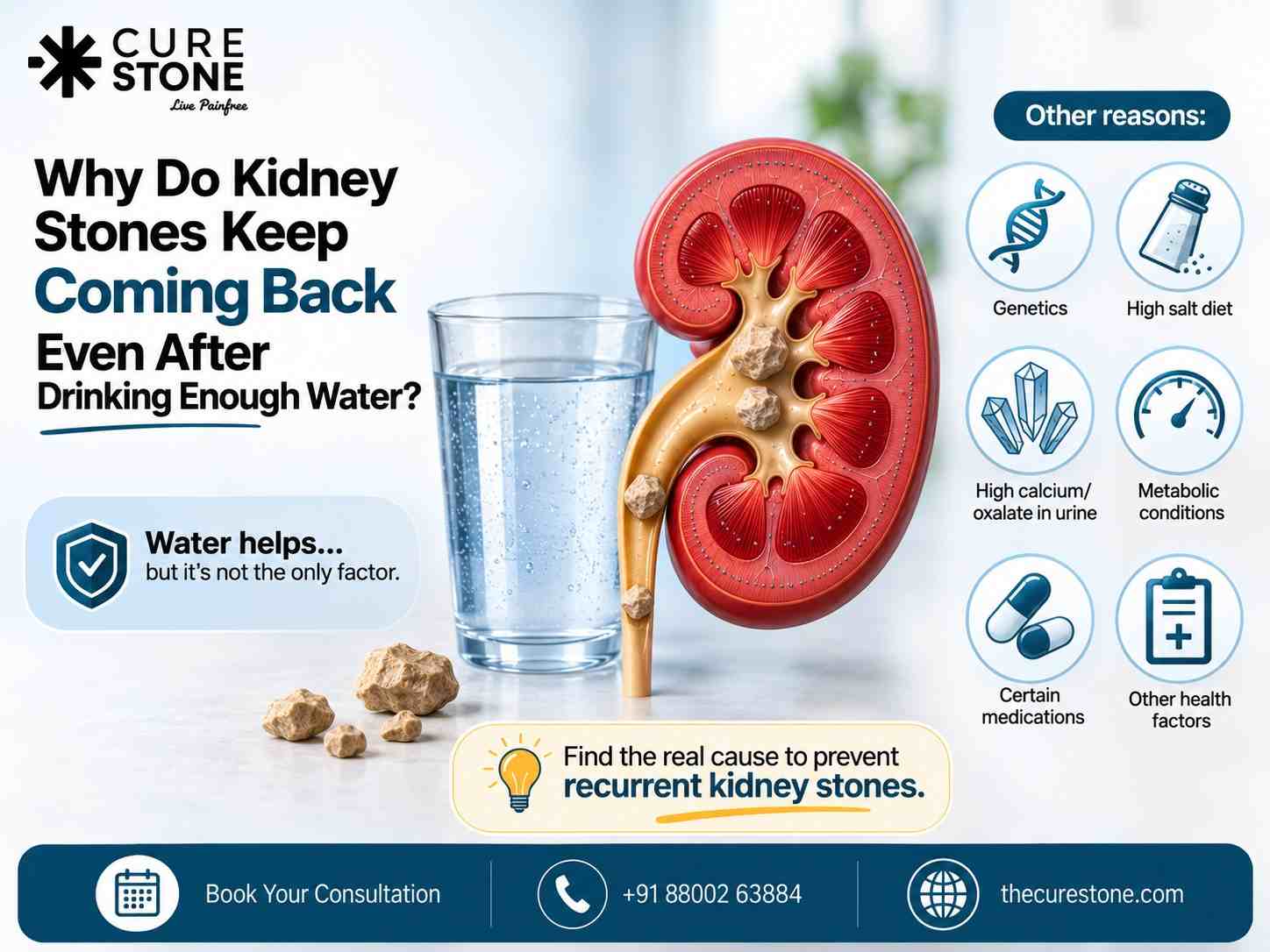
It is one of the most frustrating situations in stone care. A patient has had three or four stones. They were told to drink more water, and they did. They carry a bottle everywhere, they finish three litres a day, and they still ended up back in the emergency room at 2am with the same pain.
At that point most patients conclude that either the advice is useless or their body is simply built to make stones. Neither is quite right.
Water is the single most effective preventive measure available, and it works for a large number of people. But it only addresses one of several mechanisms that produce stones. If your problem is a chemical imbalance in the urine, a hormone disorder, an anatomical issue, or leftover fragments from a previous surgery, drinking more water will not fix it, and no amount of discipline with a bottle will change that.
Here are the real reasons stones keep coming back.
1. You Are Drinking Enough, But Not Producing Enough Urine
This is the most common explanation, and it surprises people.
What matters is not how much you drink. It is how much urine you produce. In North India, a large share of what you drink is lost through sweat and through breathing, especially between April and August, and sweat losses produce no urine at all. Someone working outdoors, commuting on a two wheeler, working near a kitchen, or training in a gym can lose well over a litre without noticing.
Air conditioning makes it worse in a different way. It suppresses the sensation of thirst while dehydration continues quietly.
The target is a urine output of at least 2 to 2.5 litres per day, which for many people means drinking three to four litres. If you have never measured your output, you do not actually know whether your intake is enough. A simple check is urine colour through the day. Pale is the goal, and consistently dark urine means the intake is not reaching the target regardless of how many bottles you finished.
Our guides on how much water you should drink to prevent kidney stones and why hydration is necessary for kidney health go into the practical numbers.
Timing matters too. Most stones form overnight, when urine sits concentrated for seven or eight hours. Drinking four litres between 9am and 6pm and nothing after dinner leaves that window unprotected.
2. Your Urine Volume Is Fine, But the Chemistry Is Wrong
This is where most recurrent stone formers actually sit, and it is invisible without testing.
Urine can be perfectly dilute and still form stones if the balance of dissolved substances is off. The main culprits:
Low citrate. Citrate is your body's natural stone inhibitor. It binds calcium so it cannot bind oxalate. Low citrate is extremely common, easily missed, and directly correctable with medication. Chronic diarrhoea, high animal protein intake, and acidic urine all deplete it.
High urinary calcium. Often driven by high salt intake rather than high calcium intake. Every extra gram of salt pushes more calcium into the urine. In an Indian diet with pickles, papad, namkeen, and restaurant food, sodium is usually the bigger lever than any other dietary change. More in calcium stones, symptoms and treatments.
High urinary oxalate. From diet, from gut absorption problems, or paradoxically from cutting dietary calcium too far. Dietary calcium binds oxalate in the gut before it reaches the kidney, so patients who stop dairy to prevent stones often make things worse. See can kidney stone patients consume milk and the 10 foods that cause kidney stones.
Persistently acidic or alkaline urine. Acidic urine favours uric acid stones. Alkaline urine favours calcium phosphate and struvite stones. See uric acid stones, complications and treatment.
None of these can be guessed at. They are measured in a 24 hour urine collection, which is covered in what to expect during your kidney stone tests.
3. There Is an Underlying Medical Condition Nobody Has Looked For
Some patients keep forming stones because a treatable disease is driving it.
Primary hyperparathyroidism. An overactive parathyroid gland raises blood and urine calcium continuously. It is diagnosed with a simple blood test for calcium and parathyroid hormone, and it is frequently missed for years. In these patients, treating the gland stops the stones. Nothing dietary will.
Renal tubular acidosis. The kidney cannot acidify urine properly, producing alkaline urine and very low citrate. It causes recurrent calcium phosphate stones and often nephrocalcinosis.
Gout and metabolic syndrome. Diabetes, obesity, and insulin resistance produce persistently acidic urine and favour uric acid stones. This group is growing rapidly in urban India.
Gut disease and malabsorption. Inflammatory bowel disease, chronic diarrhoea, and previous bariatric surgery all increase oxalate absorption and reduce citrate. See kidney stones and digestive issues.
Inherited conditions. Cystinuria and primary hyperoxaluria are rare but produce stones from a young age and require lifelong specific management. If your stones started in your teens or twenties, or several family members form stones, this is worth investigating. See hereditary causes of kidney stones.
4. Something in Your Anatomy Is Holding Urine Back
Stones form where urine sits still. If part of your urinary system does not drain properly, crystals get the time they need to grow, and no amount of fluid intake corrects a mechanical problem.
The common ones are pelvi ureteric junction obstruction, covered in PUJ obstruction, horseshoe kidney, medullary sponge kidney, ureteric strictures, and large lower pole calyces where gravity works against drainage.
If you keep forming stones in the same kidney, or always in the same location within one kidney, anatomy is the first thing I would want to rule out. Imaging is what answers this, as covered in the role of ultrasound and CT scan in diagnosing kidney stones.
5. Your Previous Surgery Left Fragments Behind
This is an underappreciated cause of what looks like recurrence but is not.
If a previous procedure cleared the main stone but left small fragments in the kidney, those fragments act as a seed. New crystals deposit on them, and within a year or two you have a stone again. It feels like a new stone. It is actually the old one regrowing.
Being genuinely stone free at the end of a procedure matters more than the procedure being called successful. This is one of the main arguments for suction assisted techniques, where fragments are actively removed rather than left to pass on their own, discussed in FANS RIRS and suction RIRS and RIRS success rate in complex kidney stones.
It is also why follow up imaging after surgery matters rather than assuming the job is done. See why aftercare and follow up are important after kidney stone surgery.
6. Infection Is Driving the Stones
Struvite stones are not caused by diet or dehydration. They are caused by specific urea splitting bacteria in the urinary tract, and they grow quickly, sometimes filling the entire collecting system as a staghorn stone.
In these patients, stone prevention means clearing the infection and removing every fragment, because a single leftover piece harbours bacteria and the stone regrows. Read struvite stones, a different kidney stone and UTI versus kidney infection.
Recurrent urinary infections alongside recurrent stones is a pattern that should always trigger investigation.
7. Your Diet Is Working Against You in Ways You Have Not Been Told
Most patients are told to avoid tomatoes and spinach. That is a fraction of the picture and often not the most important part.
The higher yield changes are usually reducing salt, moderating animal protein, keeping normal dietary calcium with meals, and adding citrate through lemon or lime. Cutting oxalate matters, but only for oxalate stone formers, and only after the bigger levers are addressed. Our guides on the right diet for kidney stones, what to eat if you have kidney stones, and the role of diet in kidney stone formation and prevention set out the full plan.
Supplements deserve a mention too. High dose vitamin C converts to oxalate, calcium supplements taken between meals can raise urinary calcium, and some medications shift urine chemistry directly. Not all supplements work against you, and vitamin B3 may work in the opposite direction.
8. Nobody Has Actually Investigated Why You Form Stones
This is the real answer for most recurrent stone formers in India.
The typical pathway is that the stone is treated, the patient is handed a printed diet sheet, and everyone moves on. The stone itself is discarded rather than analysed. No 24 hour urine is done. No blood calcium or parathyroid hormone is checked. The prevention advice given is identical for a uric acid former, a struvite former, and a calcium oxalate former, which means it is close to useless for at least two of them.
You cannot correct a mechanism nobody has identified. That is not a failure of your discipline with a water bottle. It is a gap in the workup.
A proper evaluation involves composition analysis of the stone, a 24 hour urine study, targeted blood tests, and imaging to check anatomy and confirm you are stone free. From that, the plan becomes specific: potassium citrate for low citrate, a thiazide for high urinary calcium, allopurinol or urine alkalinisation for uric acid, infection clearance for struvite, or surgery for an anatomical obstruction.
Our guides on recurring kidney stones, how to avoid kidney stone recurrence, and which factors mainly cause kidney stones cover this in more detail.
Why This Matters Beyond the Pain
Repeated stones are not just repeated episodes of pain and time off work. Each episode of obstruction carries a cost, and repeated obstruction or repeated procedures can reduce kidney function over time. This is covered in kidney stones and the risk of chronic kidney disease.
Breaking the cycle is worth doing properly once rather than treating each stone as an isolated event.
If you have formed more than one stone, our kidney stone checker gives a quick indication of what your current stone requires, and our kidney stone treatment page explains the options, including RIRS for scarless removal.
To get a full metabolic evaluation rather than another diet sheet, book a consultation with Dr. Deepanshu Gupta.
Frequently Asked Questions
Why do I keep getting kidney stones even though I drink a lot of water?
Because water addresses only urine concentration. If your stones are driven by low urinary citrate, high urinary calcium, an underlying condition such as hyperparathyroidism, an anatomical obstruction, infection, or leftover fragments from a previous surgery, hydration alone will not prevent them.
How much water is actually enough to prevent kidney stones?
Enough to produce at least 2 to 2.5 litres of urine per day, which usually means drinking three to four litres, and more in hot weather or with physical work. Intake is not the same as output, and sweat losses do not count toward urine volume.
What tests should I get if I keep forming stones?
Composition analysis of the stone, a 24 hour urine study measuring volume, calcium, oxalate, citrate, uric acid, sodium and pH, blood tests including calcium, uric acid, creatinine and parathyroid hormone, and imaging to check for anatomical problems and residual fragments.
Can kidney stones come back after surgery?
Yes, for two different reasons. Either the underlying cause was never corrected, or fragments were left behind and regrew. Follow up imaging after surgery distinguishes between the two.
Is recurrent kidney stone formation genetic?
It can be. Family history is a recognised risk factor, and specific inherited conditions such as cystinuria and primary hyperoxaluria cause stones from a young age. Most recurrent stone formers, though, have a correctable metabolic or dietary cause rather than a genetic one.
Does cutting out calcium stop recurrent stones?
No, and it often makes them worse. Dietary calcium binds oxalate in the gut so it never reaches the kidney. Reducing salt and moderating animal protein are far more effective changes than cutting calcium.
How soon can another stone form?
It varies widely. With an untreated underlying cause, a new stone can appear within a year. With residual fragments left after surgery, regrowth can be faster still. With a corrected cause and good follow up, many patients go years without another episode.
Can lemon water prevent kidney stones?
Lemon and lime provide citrate, which is a genuine stone inhibitor and helpful for many stone formers. It is a useful addition rather than a complete solution, and for patients with significantly low citrate, prescribed potassium citrate is considerably more effective.
Have Questions About This Topic?
Get a personalized consultation at Cure Stone Hospital, Sector 52, Gurgaon.
Book Consultation